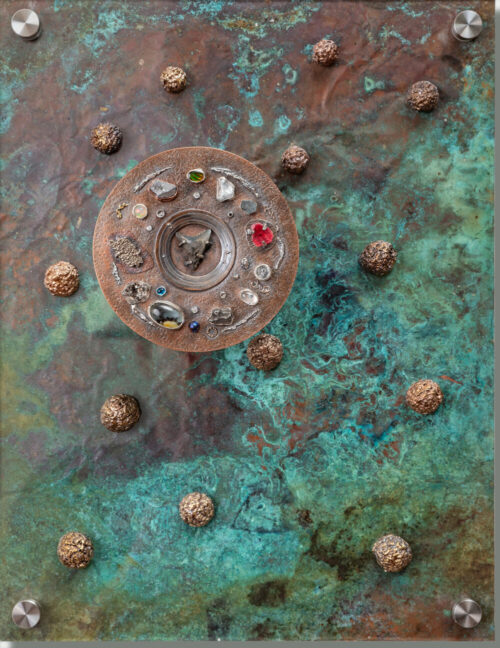
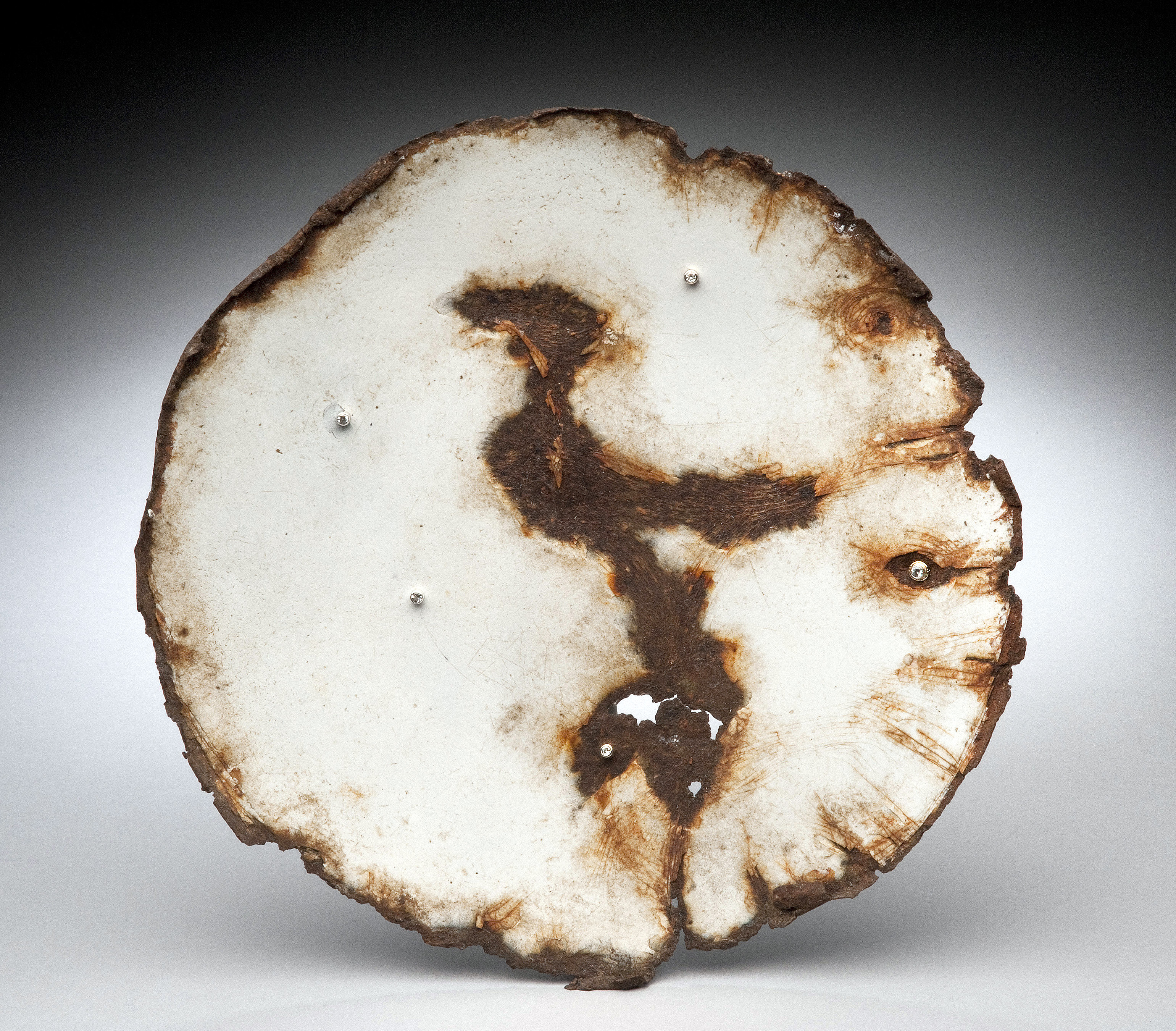
Polymetallic Nodules — Copper, sterling silver, 18K ,14K gold, bronze, brass, iron, nickel, zinc, cobalt, chromium, magnetite, titanium (metals). Diamond, apatite, Medusa quartz, petroleum quartz, rhodonite, ammonite, shark tooth, acrylic. 12” x 12” x 3.5” — see description at end of page
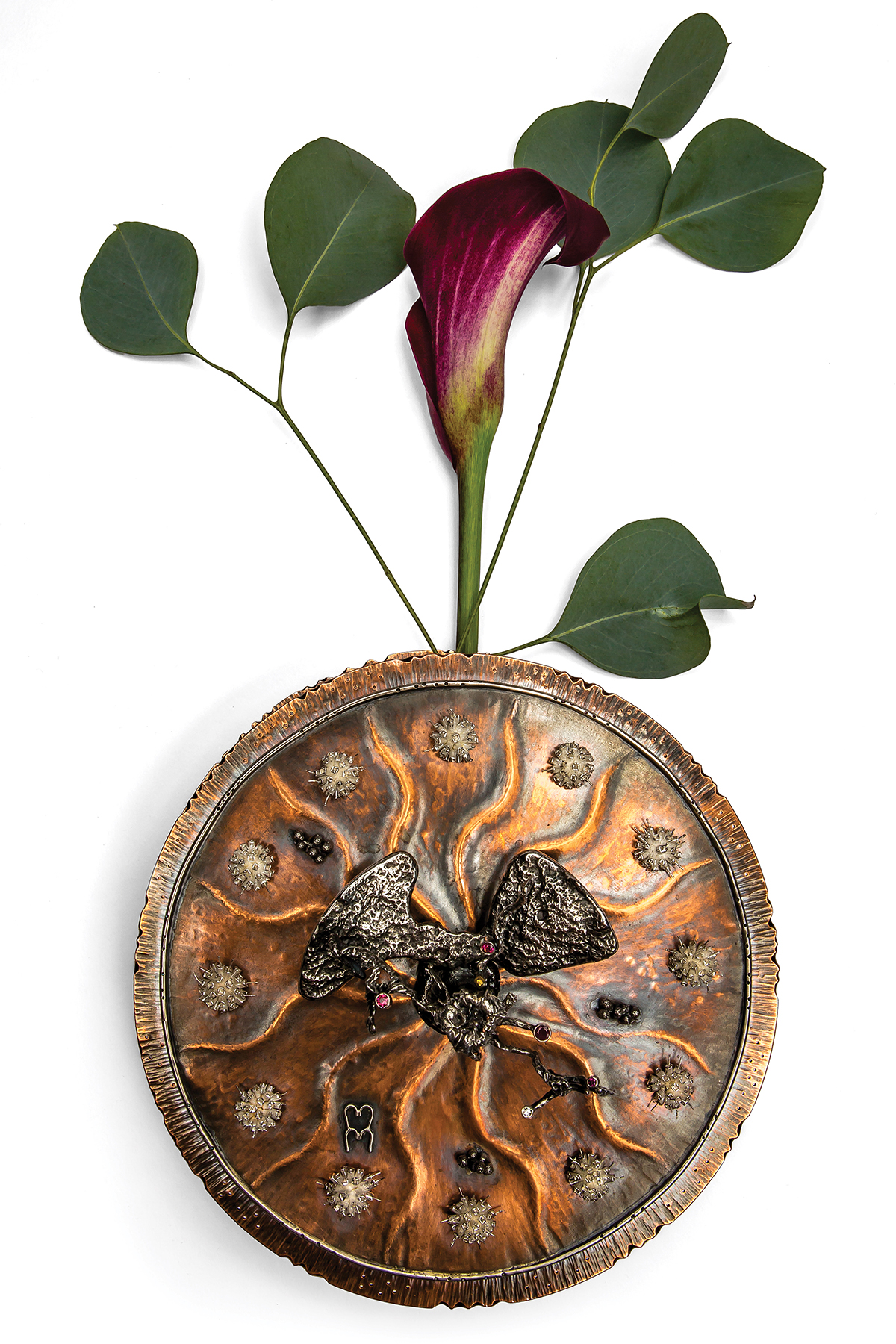
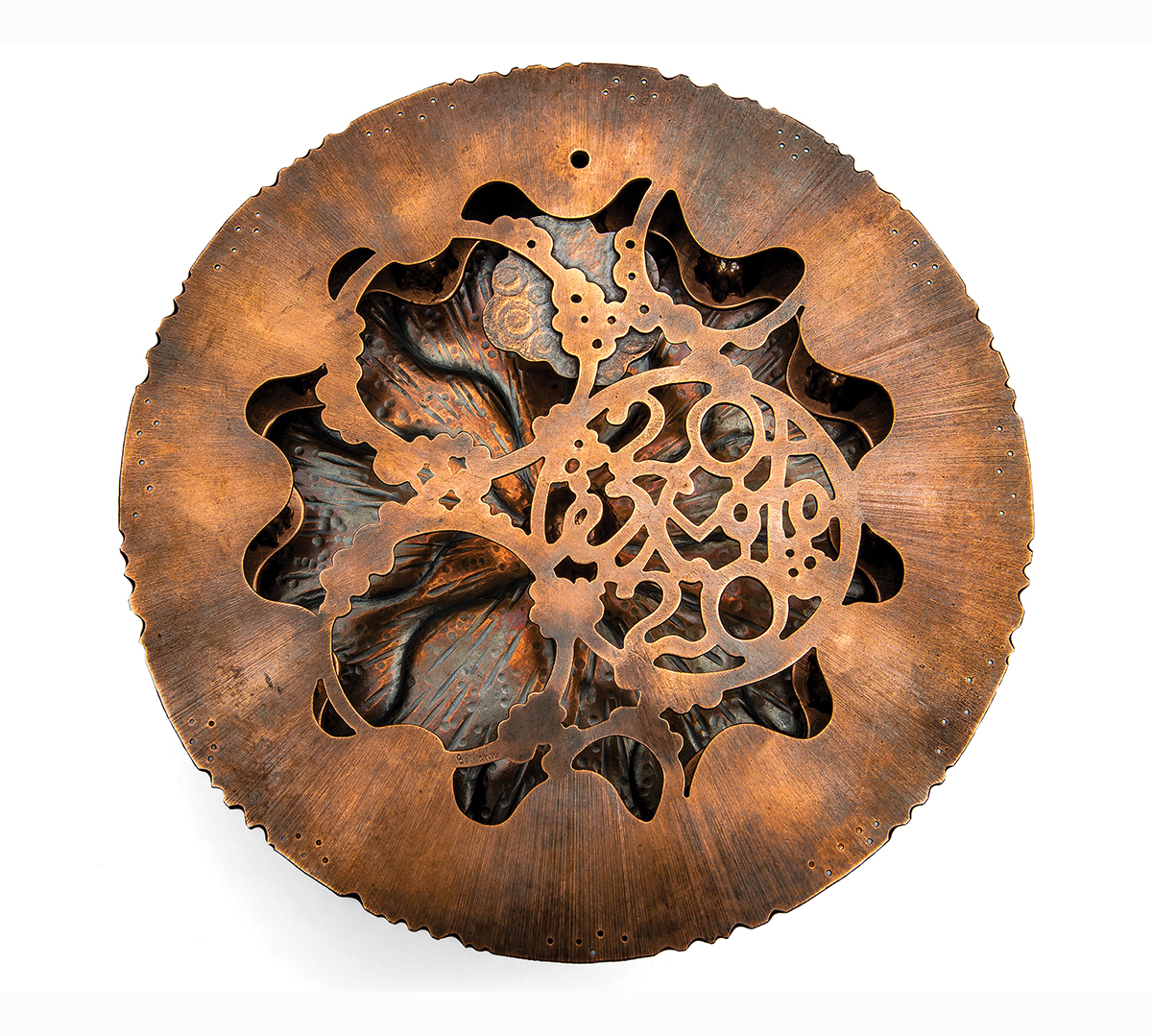
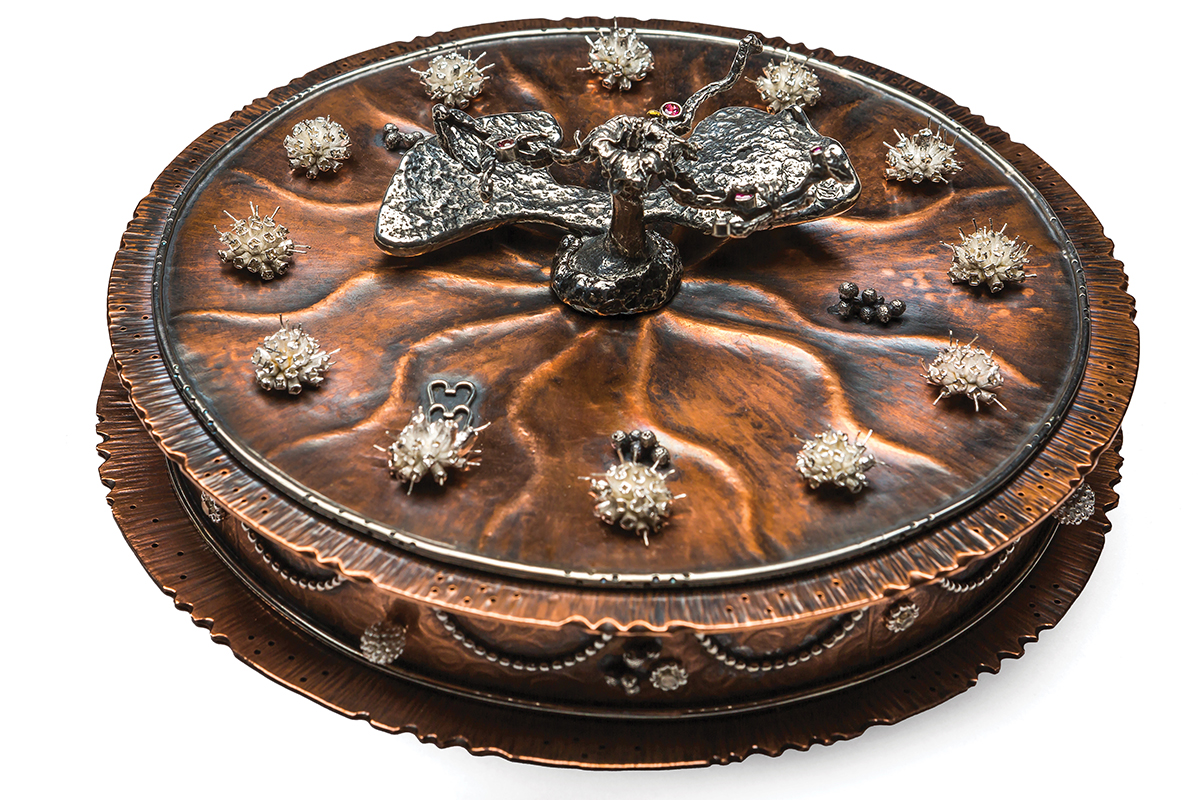
Covid-19 Ex-voto Wall Vase — copper, sterling silver, brass, 14K gold, rubies, garnet, diamond — see description at end of page

sterling silver, 14K gold, pearl, coral
see description at end of page
sterling silver
sterling silver, coral
see description at end of page
sterling silver, 18K gold, coral, diamond, sapphire — see description at end of page
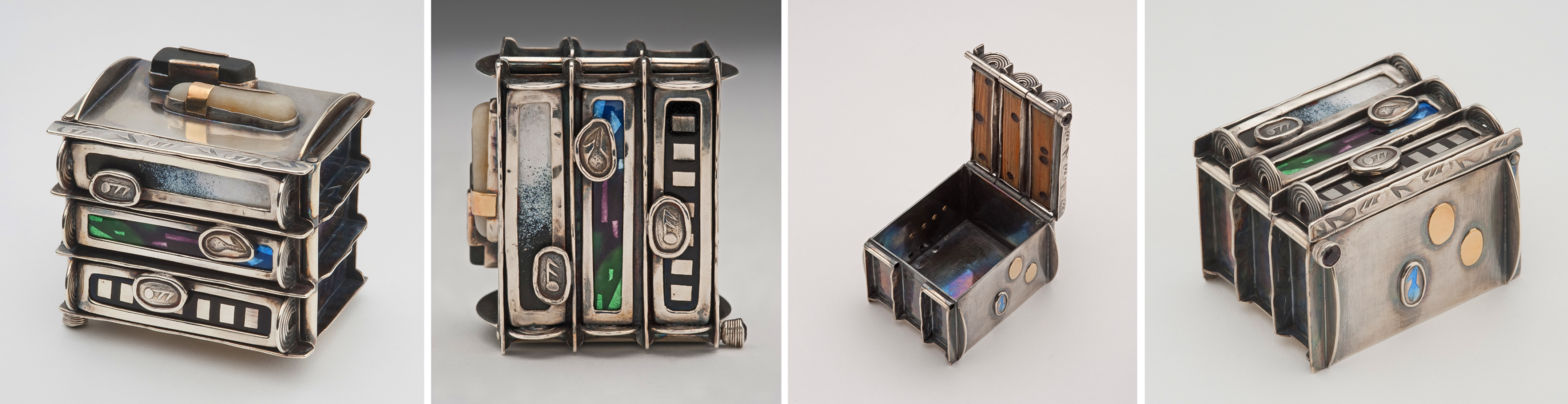
sterling silver, 14K gold, enamel, Mexican jade, amethyst, pine wood
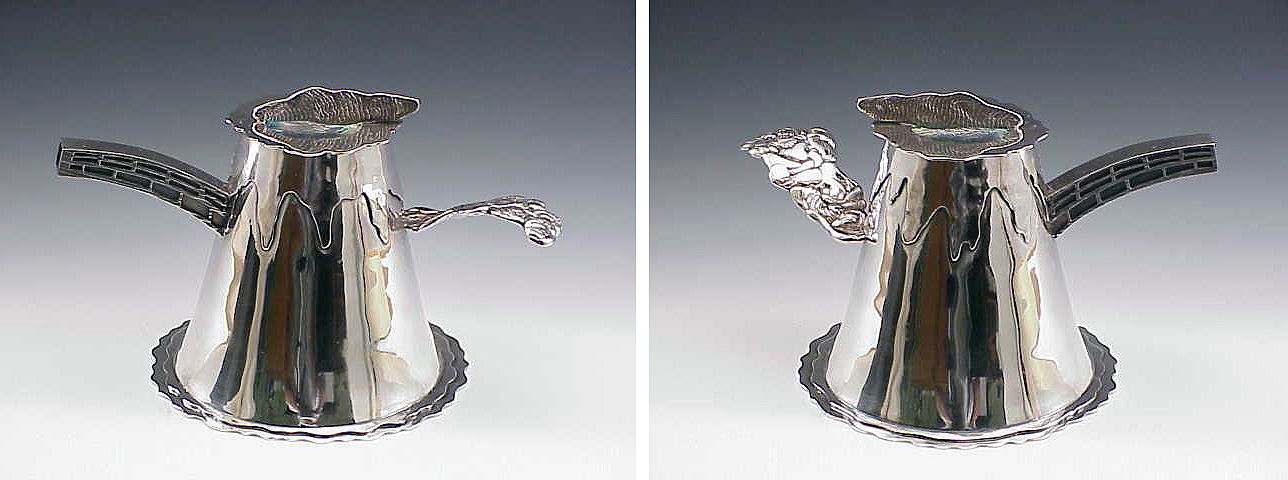
sterling silver
see description at end of page
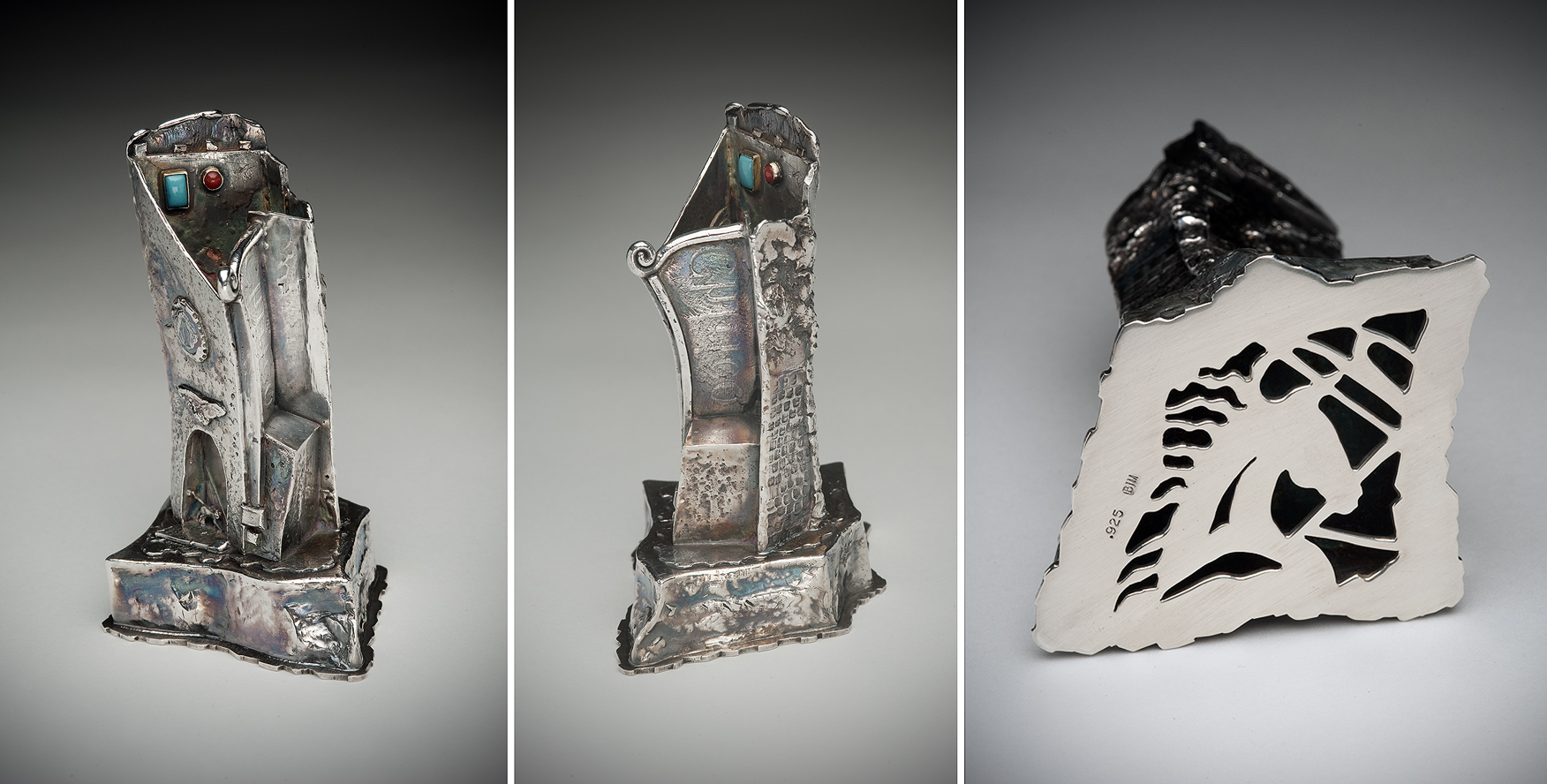
 Cortona Landscape Spoon — sterling silver — see description at end of page
sterling silver, titanium, agate, pearl, coral
see description at end of page
D e s c r i p t i o n of S e l e c t e d O b j e c t s
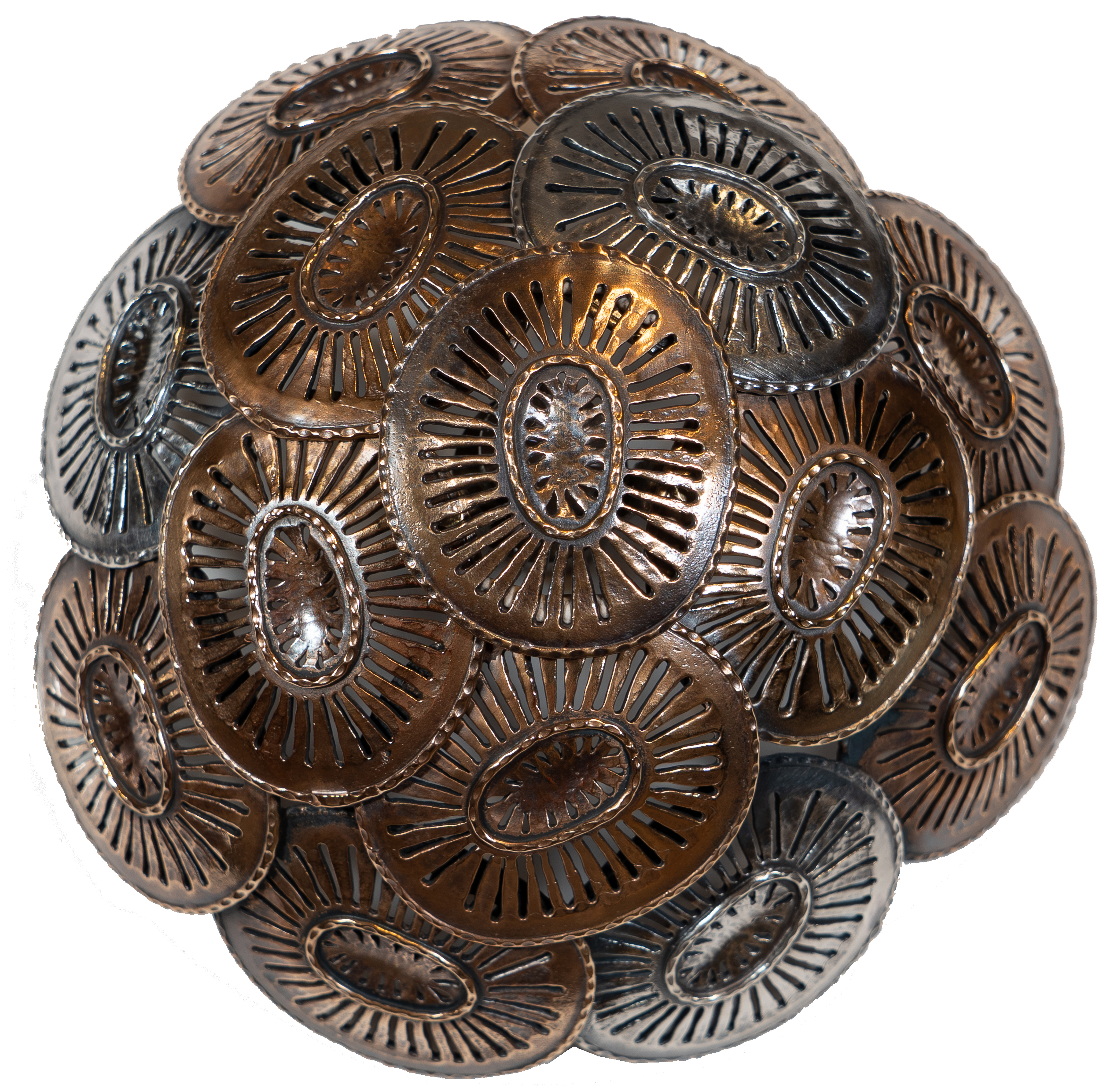
Polymetallic Nodules — I have made a small-scale view of a very large area of the abyssal deep-sea floor with a close-up view of one object, a mineral-bearing nodule. On the sea floor are polymetallic nodules which contain metals and rare earth elements (REE) that can be used in batteries, and environmental and energy technology. These nodules, about the size of a potato, are usually between 8 to 32 million years old. More than 600 different types of animals have been found living on these nodules. Living within the nodules are diverse microbial communities. With new specialized technologies, the mining of these nodules is possible and economically feasible. The mining of ocean metals is experimental, controversial and the effects on the deep-sea environment are unknown. My goal is to raise awareness of this evolving industry. — Copper, sterling silver, 18K ,14K gold, bronze, brass, iron, nickel, zinc, cobalt, chromium, magnetite, titanium (metals). Diamond, apatite, Medusa quartz, petroleum quartz, rhodonite, ammonite, shark tooth, acrylic. 12” x 12” x 3.5”
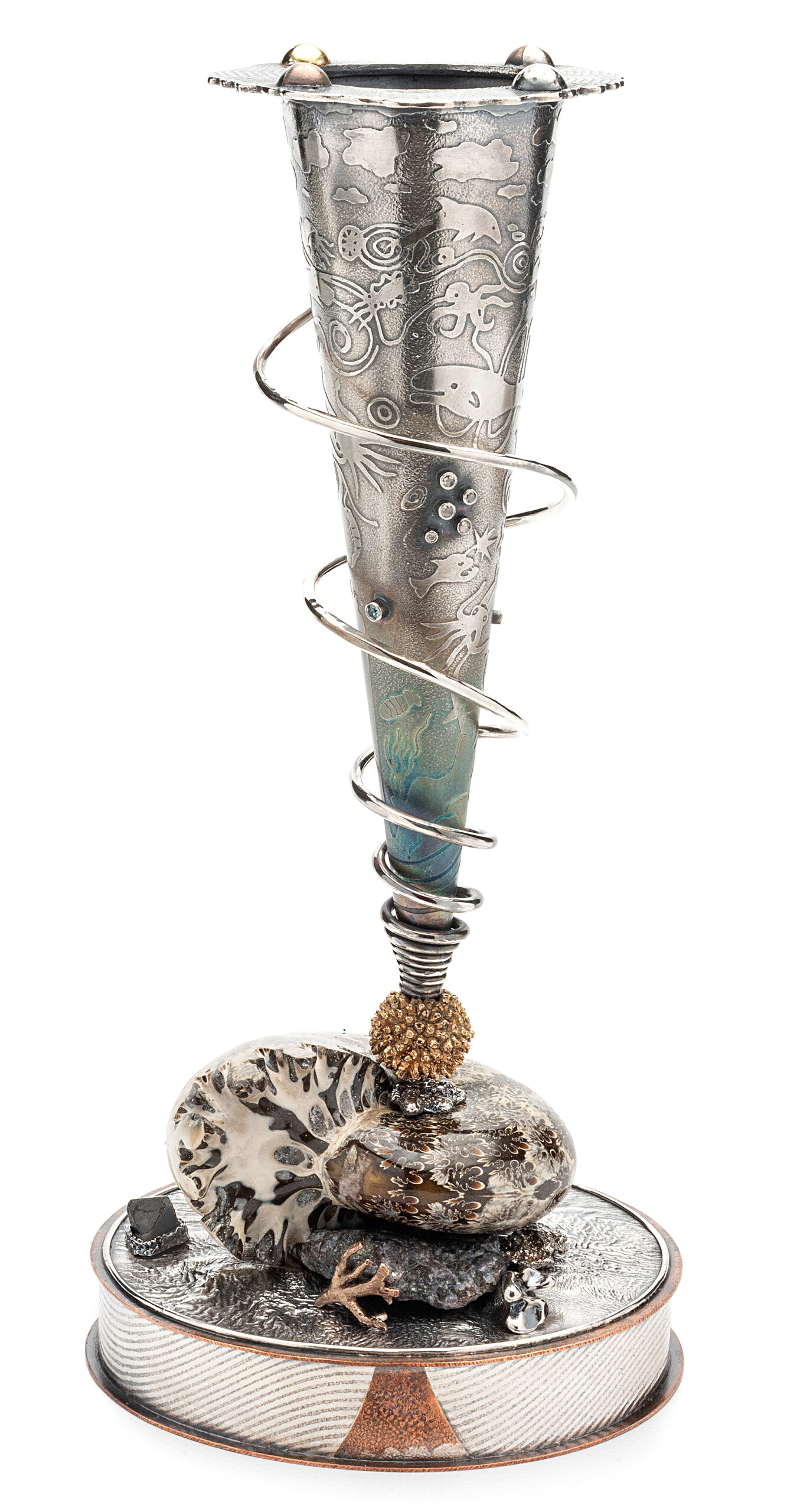
The Marine Carbon Cycle Vase is a representation of the large-scale marine carbon cycle — from the sun and the moon through the atmosphere, to the land, and seawater to the ocean floor, to seabed volcanoes and tectonic plates. On the top layer of the vase is a brass hemisphere suggesting the sun. There are three more hemispheres suggesting the phases of the moon. The sun and moon are on a textured sheet of cuttlefish-bone-cast silver. The shape of the silver piece suggests clouds in the atmosphere, and the texture suggests waves.
The sun’s light is absorbed by plants on land and in the ocean. The process of creating life from light is photosynthesis. This is a large part of the carbon cycle.
The central section of the vase is cone-shaped to evoke a feeling of descending through space and time. The surface of the cone is etched with images of clouds, a mangrove tree, land volcanos, in a descending sequence, into the various depths of the ocean: sunlight, twilight, abyssal, hadal. The spiraling silver wire encircling the cone implies movement, currents and continuity.
Also included is a vertical section of the North Atlantic Ridge from a drawing by the famous American oceanographer, Matthew Fontaine Maury (1806-1873). Various sea creatures and plants are etched on the surface. Five white diamonds, pure carbon, are set in the midsection, suggesting marine “snow,” falling organic detritus, from the upper layers of the ocean water column to very deep waters. This is a food source for life in the dark depths. It is an important part of the carbon pump, the marine cycling and sequestration of carbon. In the deepest part of the ocean (hadal), where there is no sunlight, aquatic life there can be bioluminescent, represented by the blue diamonds that are set into the surface of the vase.
The cone rests on a textured bronze sphere representing microscopic plankton. The sphere is secured to a fossil ammonite which sits on the reticulated silver ocean floor, with ocean currents, volcanoes and tectonic plates represented in copper and silver. Ammonites were sea creatures that once were widely distributed but have been extinct since the Cretaceous Period. Ammonites’ coiled shape resembles a ram’s horn. Surrounding the ammonite are various materials. The large gray rock is gabbro. It is a coarse-grained igneous rock formed from the slow cooling magma deep within the earth. Gabbro is commonly found in the oceanic crust and around volcanoes. Also placed near the fossil ammonite is a peridot crystal. Peridot, along with diamond, is one of only two gems that is formed not in the Earth’s crust, but in molten rock of the upper mantle. A magnetite crystal is near the peridot on the vase. Magnetite is a mineral, and one of the main iron ores. It is magnetic and in ancient times was used to form a magnetic compass. Magnetite has been a critical tool in the science of paleomagnetism, which helps date geologic events. sterling silver, copper, bronze, brass, fossil ammonite, gabbro, diamonds, magnetite iron, peridot crystals, zircon. 8″ x 4″ x 3′
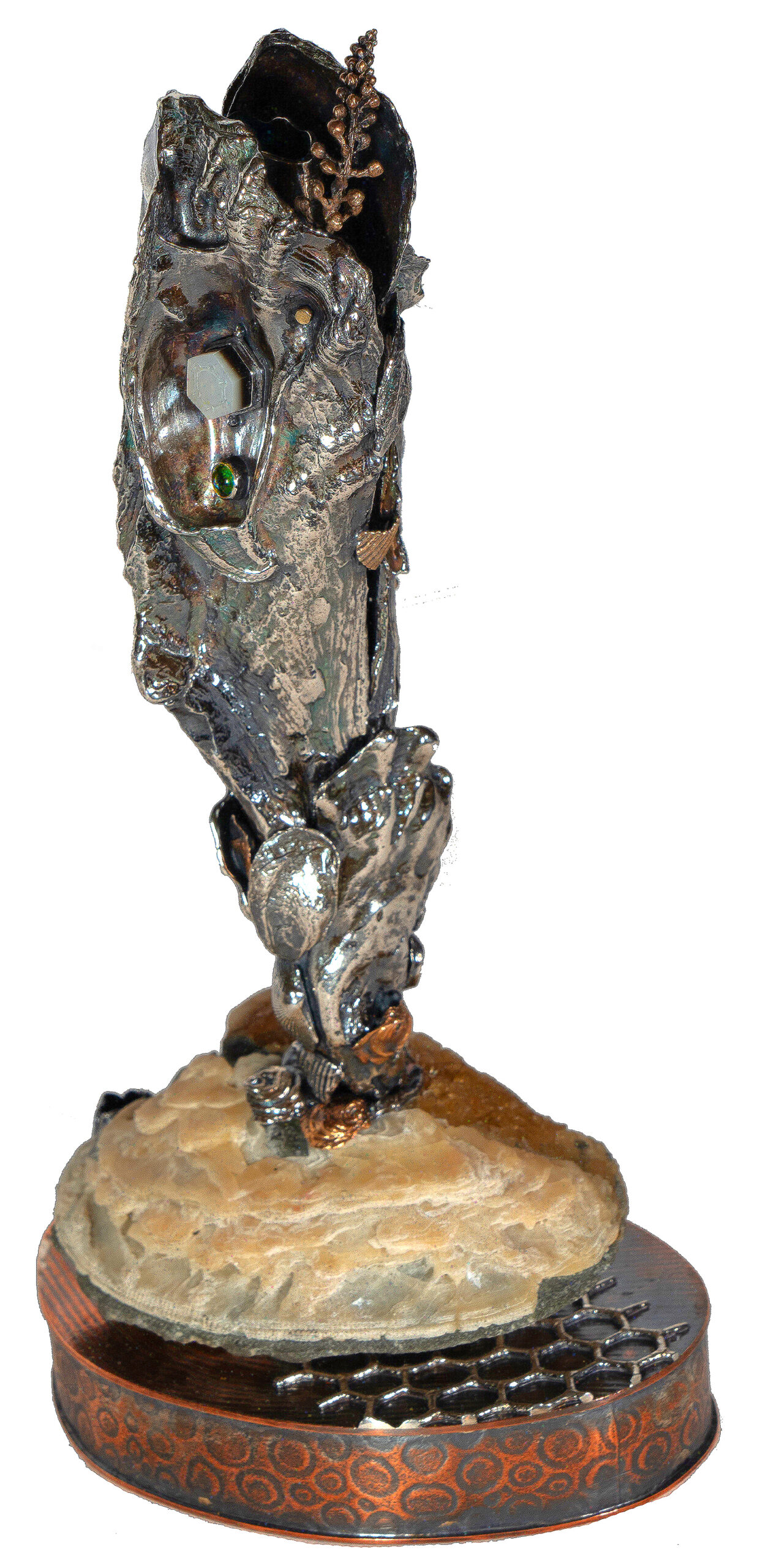
Oyster Vase — sterling silver, copper, bronze, brass, fossil clam with calcite, mother of pearl, amethyst, diamonds, peridot. 8” x 3” x 3”
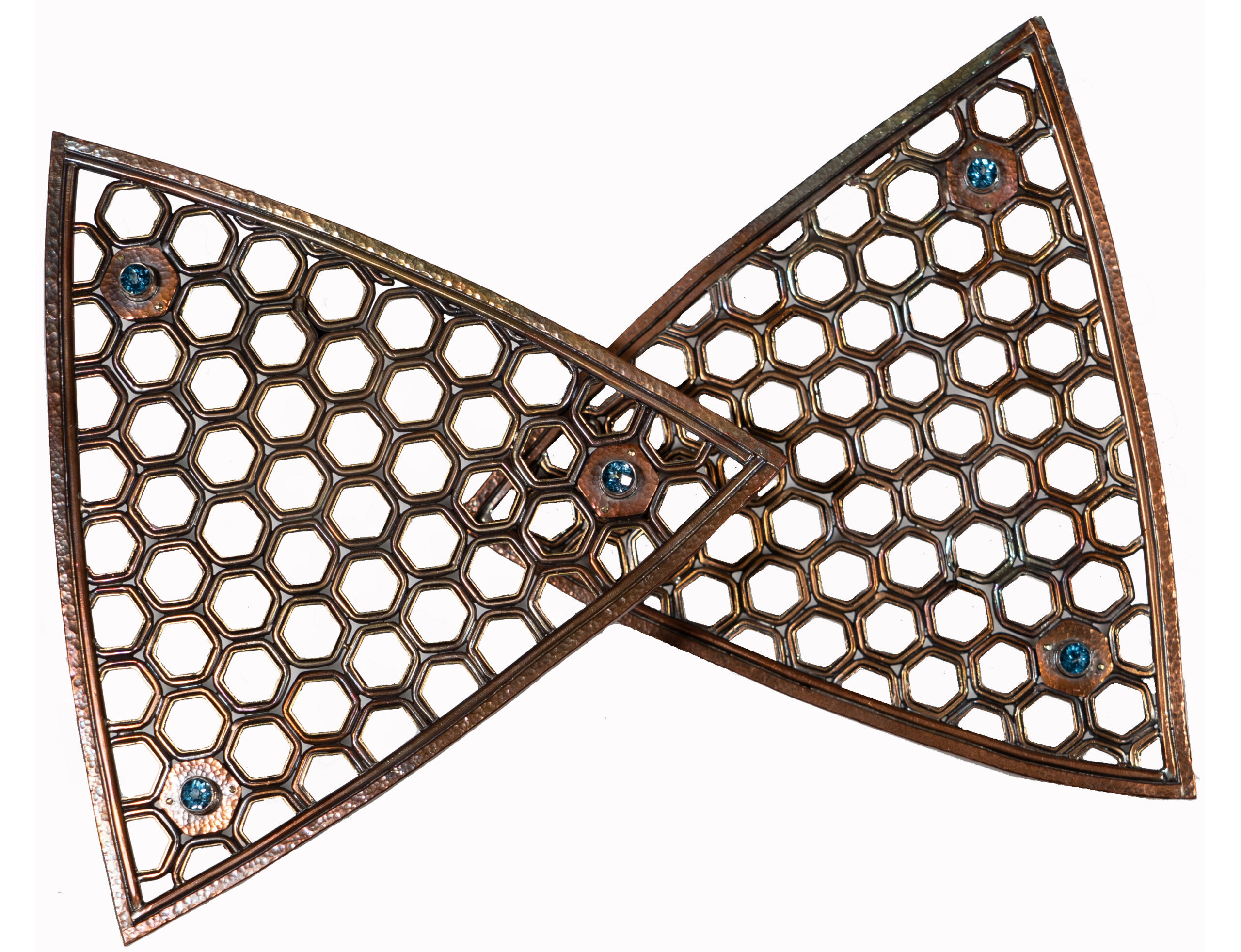
Triceratium Wall Piece — This piece represents two microscopic marine organisms (Triceratium favus) copper, brass, bronze, sterling silver, Swiss blue topaz. 7” x 9” x 2″
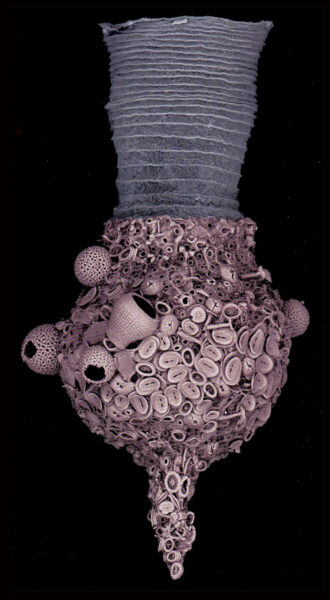
Plankton, Lorica of a Tintinnid Wall Piece — The microscopic, single-celled marine organism (a tintinnid ciliate) that I have represented is a Codonellopsis orthoceras, a microzooplankton, or “drifter.” They are a vital link in the aquatic food chain. They build a gelatinous, protective case (a lorica), around them which is conical or vaselike. Other mineral particles attach to the surface of the lorica; in my representation they are coccolithophores. The topmost part of my depicted lorica is fold formed copper. copper, sterling silver, bronze, pearls. 5″ x 12″ x 2″
Coccolithophore, Wall Piece — My representation of these beautiful, delicate marine organisms is composed of abstracted shapes and forms of the coccolithophores. It is constructed of sterling silver, bronze and brass. Coccolithophores are tiny single-celled marine organisms that are part of the phytoplankton community. Phytoplankton, “drifters in water,” perform nearly half of the photosynthesis and oxygen production on Earth. They are a crucial part of the marine food web and carbon cycle. Coccolithophores surround themselves with “plates,” coccoliths. “Coccolithophores make their coccoliths out of one part carbon, one part calcium and three parts oxygen (CaCO3). So each time a molecule of coccolith is made, one fewer carbon atom is allowed to roam freely in the world to form greenhouse gases and contribute to global warming” (earthobservatory.nasa.gov). When the coccolith sinks to the bottom of the ocean, it becomes part of the sediment, sequestering carbon. Coccoliths are preserved in a continuous fossil record for the last 200 million years and are used to collect data for climate and ocean studies. The White Cliffs of Dover, a UNESCO Heritage Site, are the accumulation of coccolithophores over millions of years on the seabed, which became exposed and is now at sea level. “Emiliania huxleyi is the most prominent coccolithophore and has attracted the attention of scientists from fields as diverse as geology, biogeography, paleoclimatology, ecophysiology, material science, and medicine. E. huxleyi is also of interest to those in biotechnology” (The Genome Portal of the Department of Energy Joint Genome Institute). copper, bronze, brass, sterling silver. 4″ x 4″ x 2″
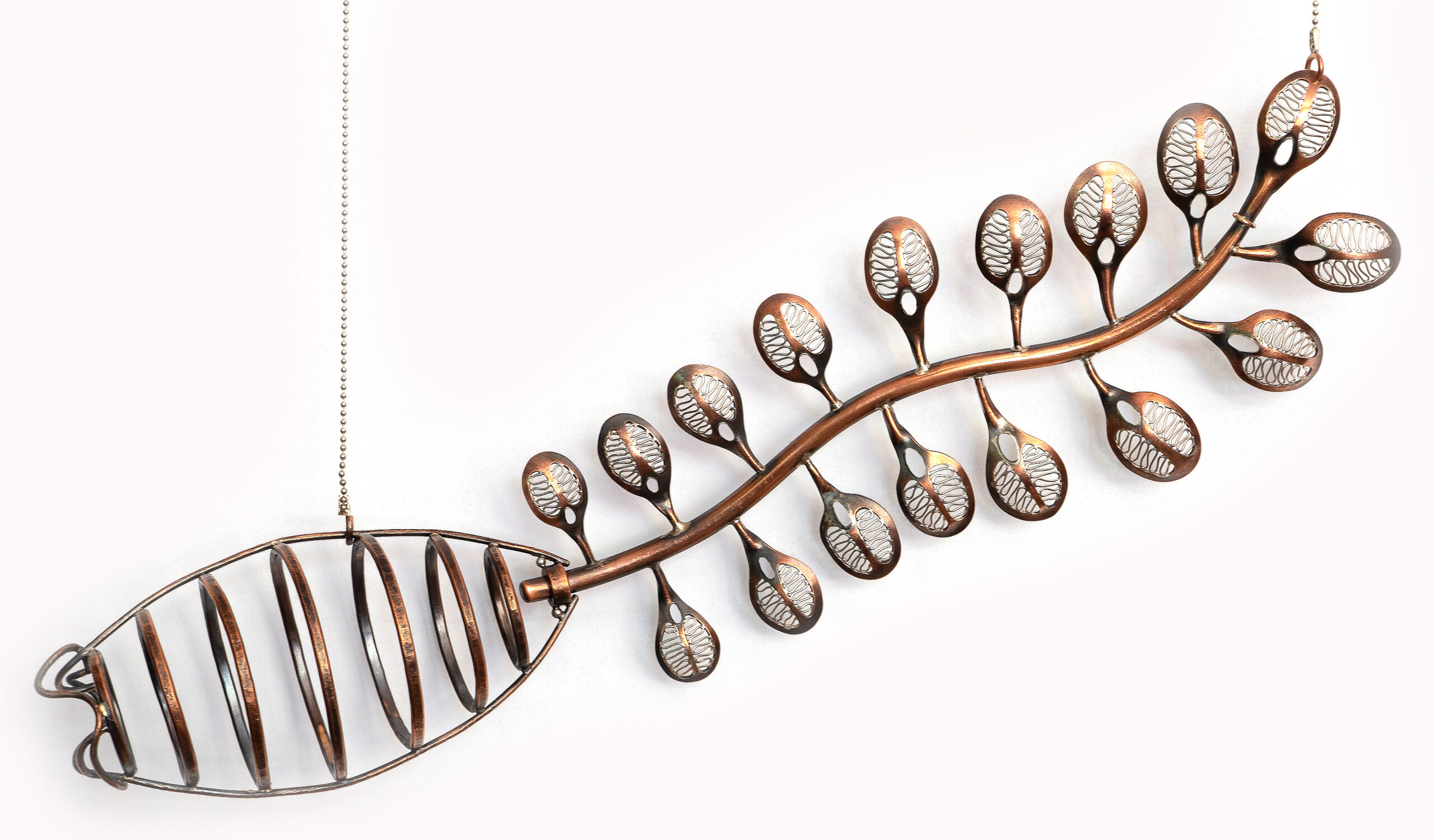
Doliolid Nurse Wall Piece — My wall piece of a doliolid nurse was inspired by Dr. Adam Greer’s shadowgraph video images of doliolids and other plankton. Dr. Greer is an Assistant Professor of Marine Sciences at the University of Georgia’s Skidaway Institute of Oceanography (SkIO). I met Dr. Greer at (SkIO) while visiting the campus to research plankton for my Sea Grant project. copper, sterling silver, brass. 12″ x 3″ x 2-1/2″
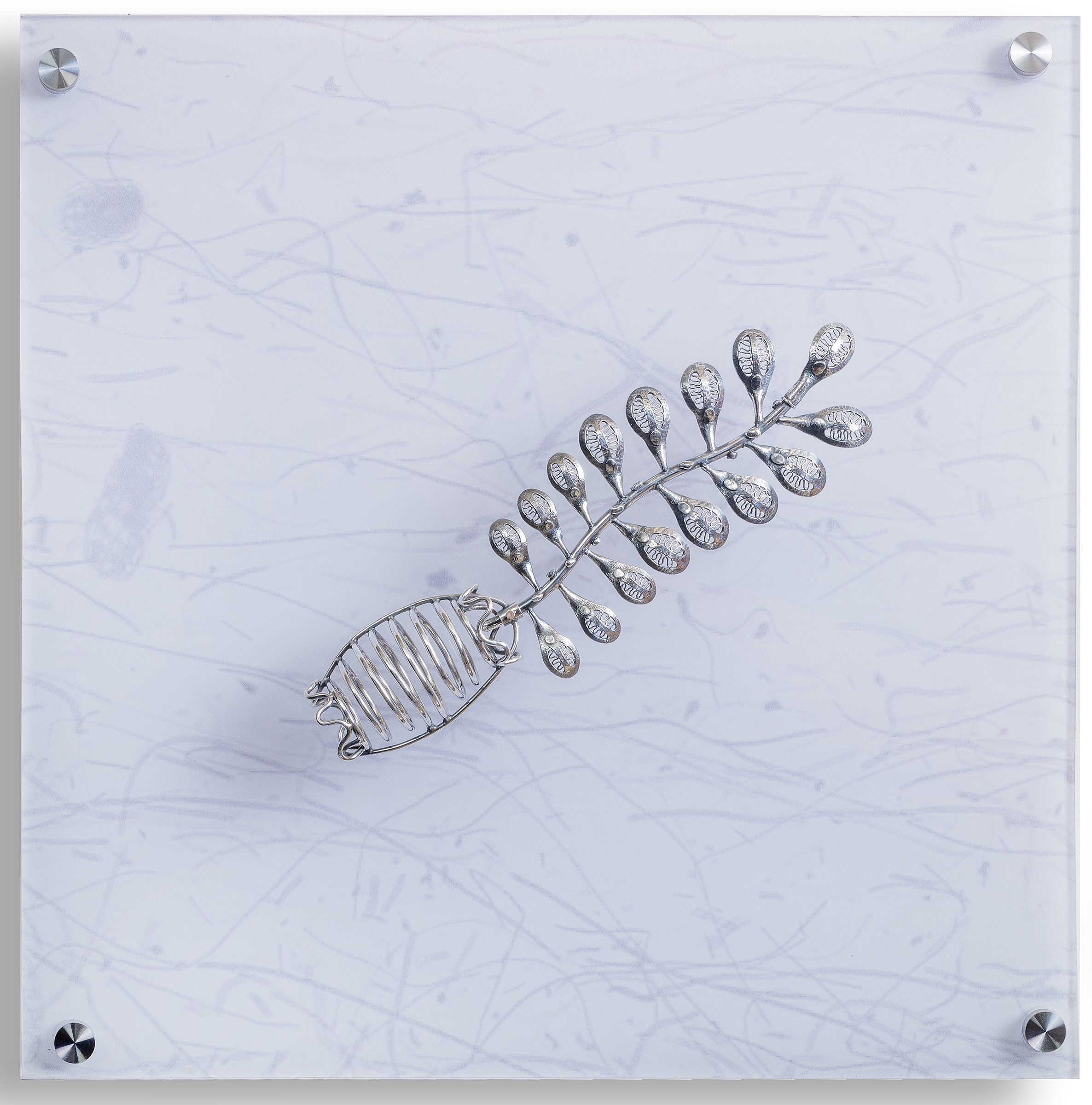
Doliolid Nurse Wall Piece 2 — This sterling silver wall piece is a smaller rendition of my copper doliolid (above). It is displayed on a Lexan sheet with images of doliolids and other plankton. It was shown at the 7th International Zooplankton Production Symposium at the University of Tasmania in Hobart, Tasmania, Australia in March 2024. It is on permanent display at the Institute for Marine & Antarctic Studies (IMAS), University of Tasmani, Hobart, Australia. sterling silver 7″ x 2″ x 1-1/2″ on 12″ x 12″ Lexan
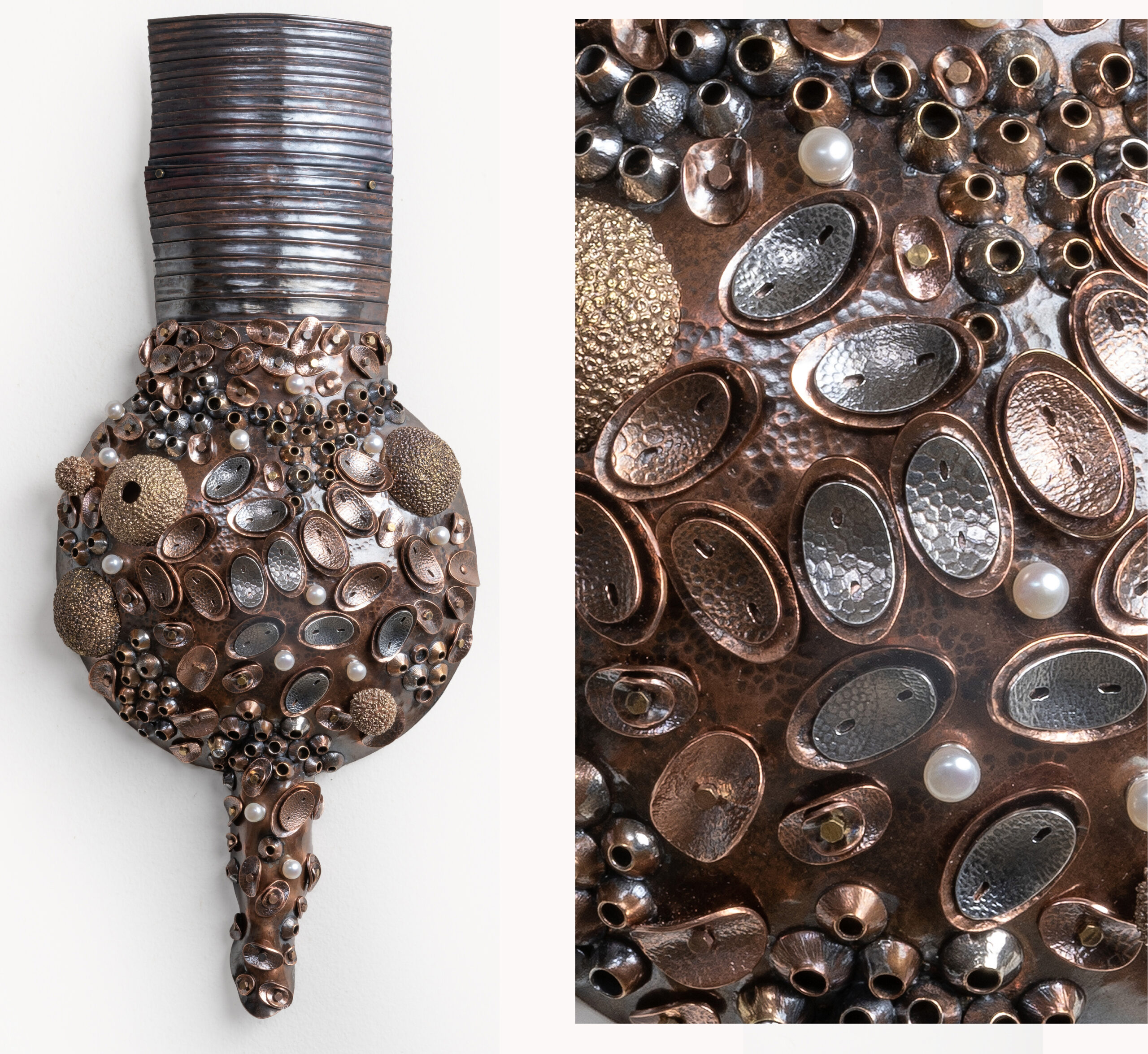
Covid-19 Ex-voto Wall Vase — Surviving the Covid 19 pandemic in 2020, I made an ex-voto, an offering to the divine, in gratitude for survival. The copper and silver wall vase depicts lungs expelling the virus. The form of the vase refers to a crown, the name of the Corona virus whose surface has crown like projections on the surface. The face of the vase has 12 silver corona virus molecules at 12 points suggesting the hours on a clock and the round-the-clock persistence of the progression and spread of the contagion. The 12 hours have expanded to 12 months. The surface texture and pierced reverse side of the copper depict a series of overlapping circular virus shapes. The silver, cast pair of lungs expel the virus with red rubies and a white diamond representing respiratory droplets and viral shedding. copper, sterling silver, brass, 14K gold, rubies, garnet, diamond, 6″ x 6″ x 2.5″
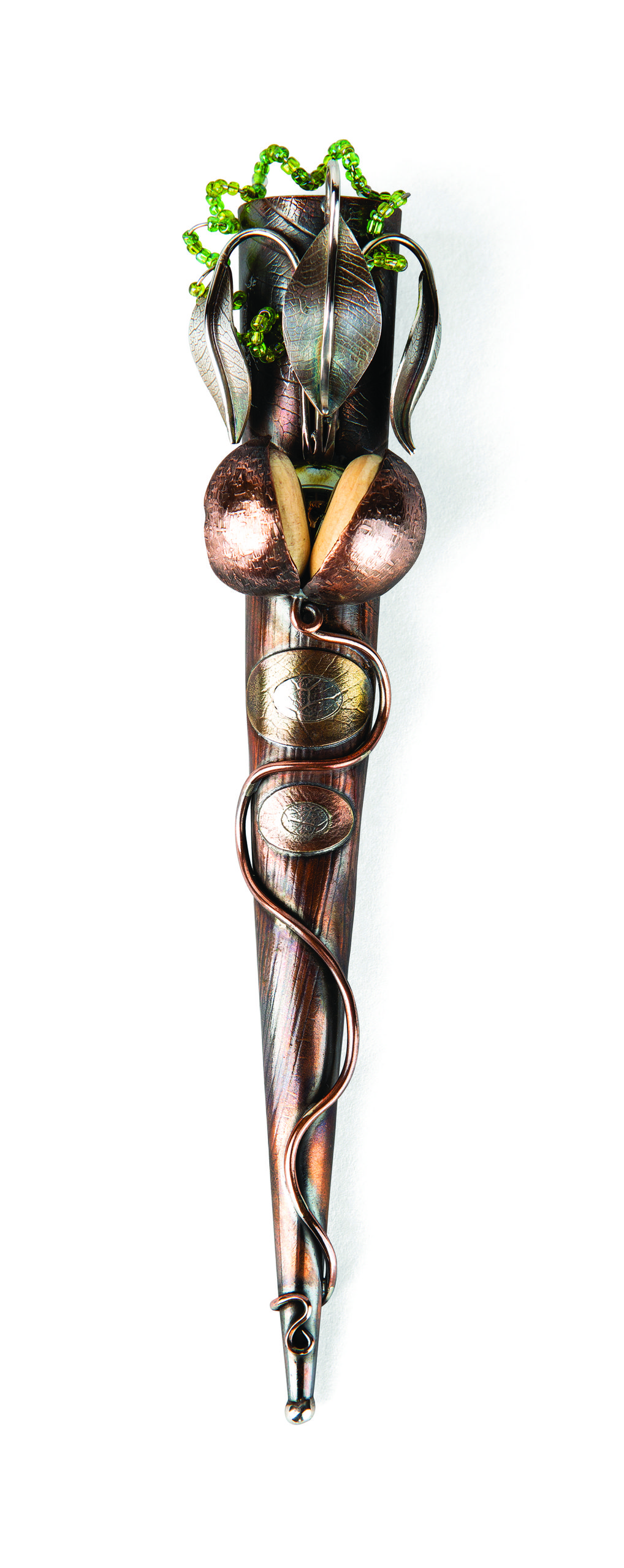
Seed to Plant Wall Vase — This wall vase was made for an exhibition, on the theme of Transformation, at the Carter Presidential Library in Atlanta. I chose to represent the life cycle of a plant from seed to mature plant. The seed pod is wood, the embryo green glass, the taproot is a copper wire which undulates down the vase between two cellular shapes, terminating in a sphere. The cone form of the vase suggests plant growth from small to large. Silver leaves and green glass vintage beads on a steel wire suggesting a tendril are at the opening of the vase. The piece was fabricated in copper, silver, brass, steel, glass, and wood. It was sawn, hammered, roller-printed, soldered, polished, and patinated.
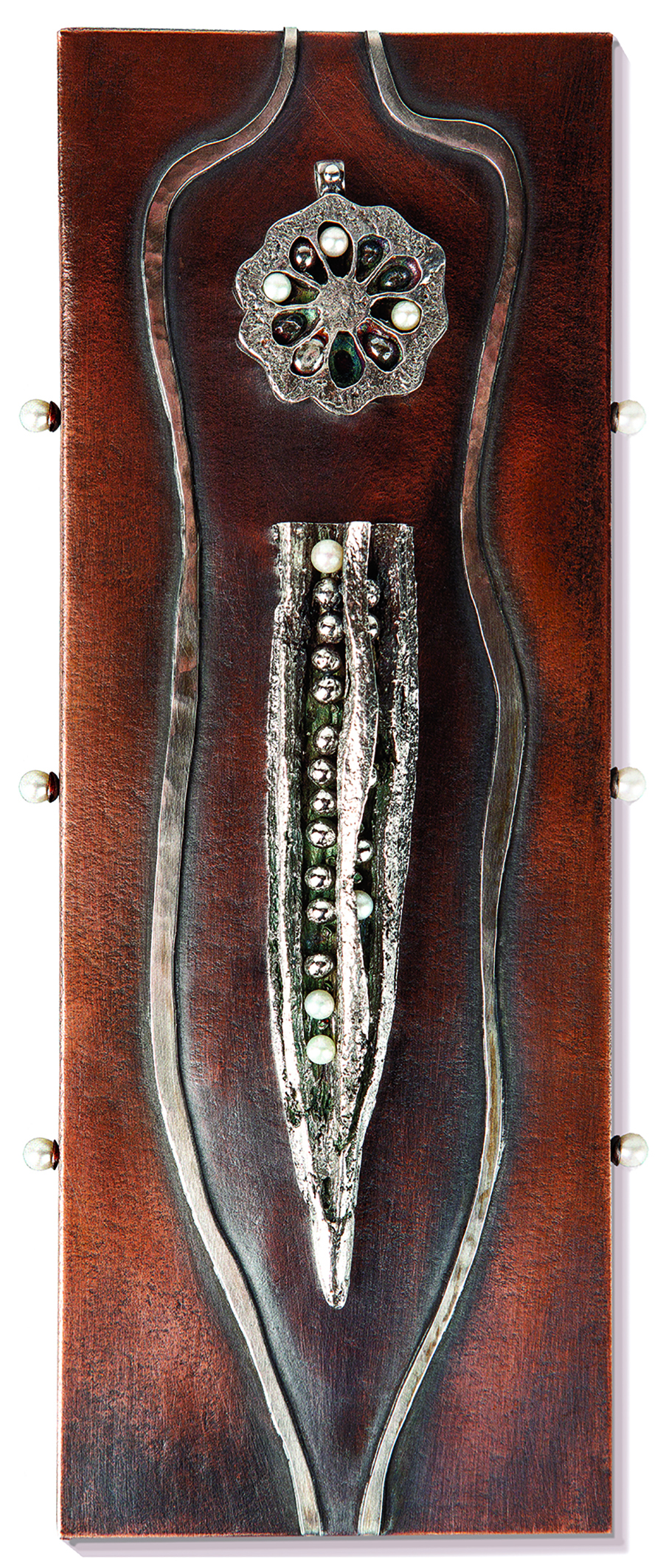
Okra Wall Vase — sterling silver, copper, pearls, wood. 8 x 4 x 1.5″
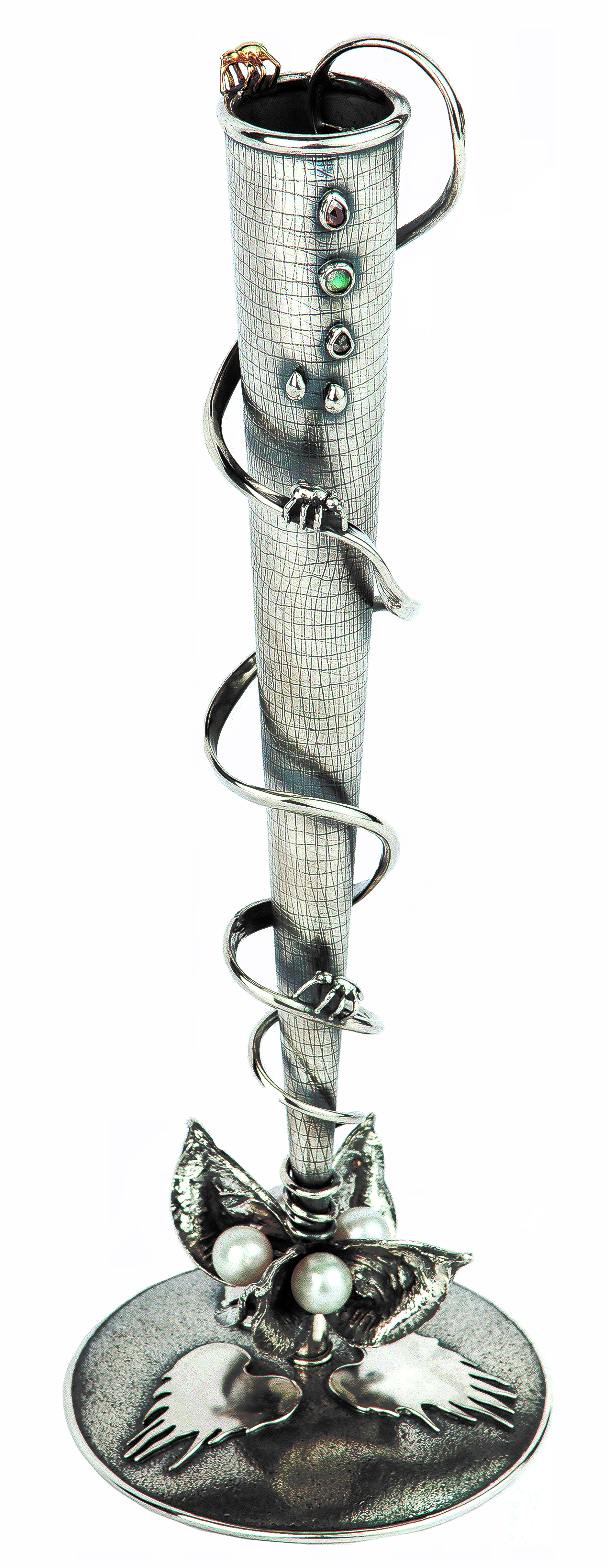
Cotton Vase — The history of cotton is the history of world civilization. Domesticated for over 5000 years, cotton is a part of most people’s lives every day. Slavery, the industrial revolution, the Civil War, and the current genetically-modified cotton are part of our history. My Cotton Vase brings together the form of a cotton mill spindle with a cotton fiber encircling it. Silver boll weevils are climbing up and evolving to gold boll weevils, symbolizing the process of the insects adapting to today’s genetically-modified Bt cotton plant. sterling silver, fine silver, 14K gold, pearls, diamonds, labradorite, brass. 8.5” x 3” x 3”
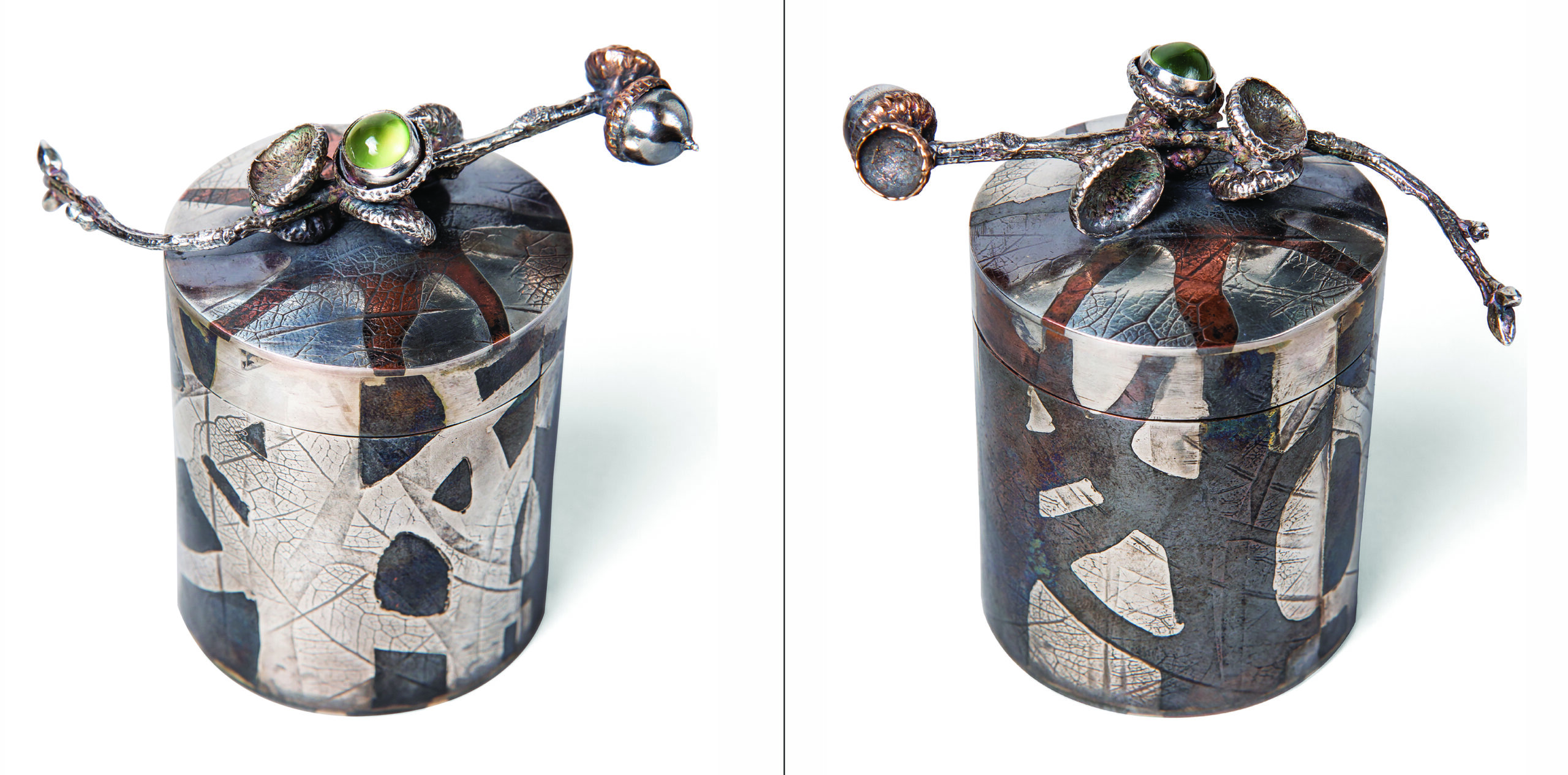
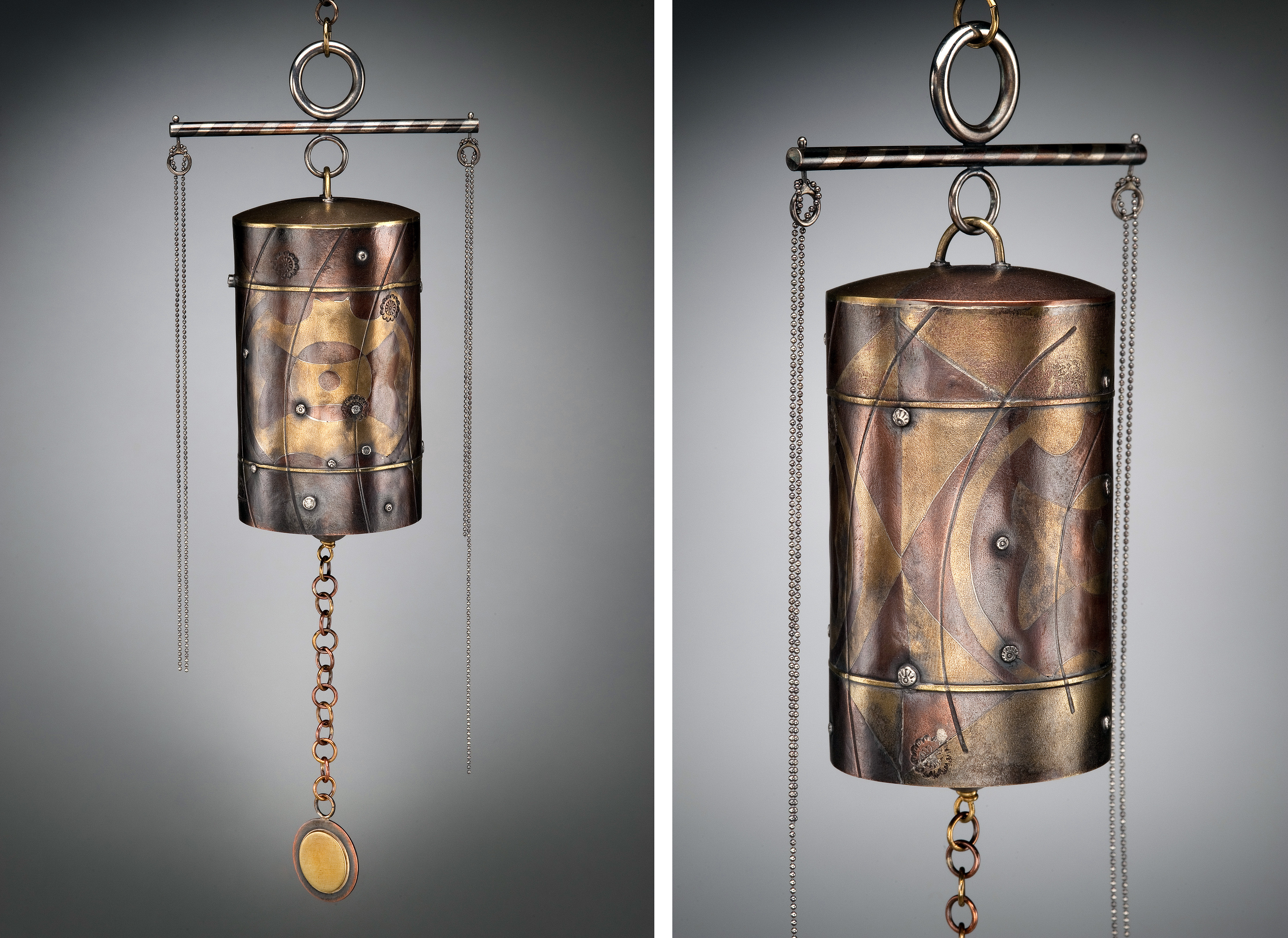
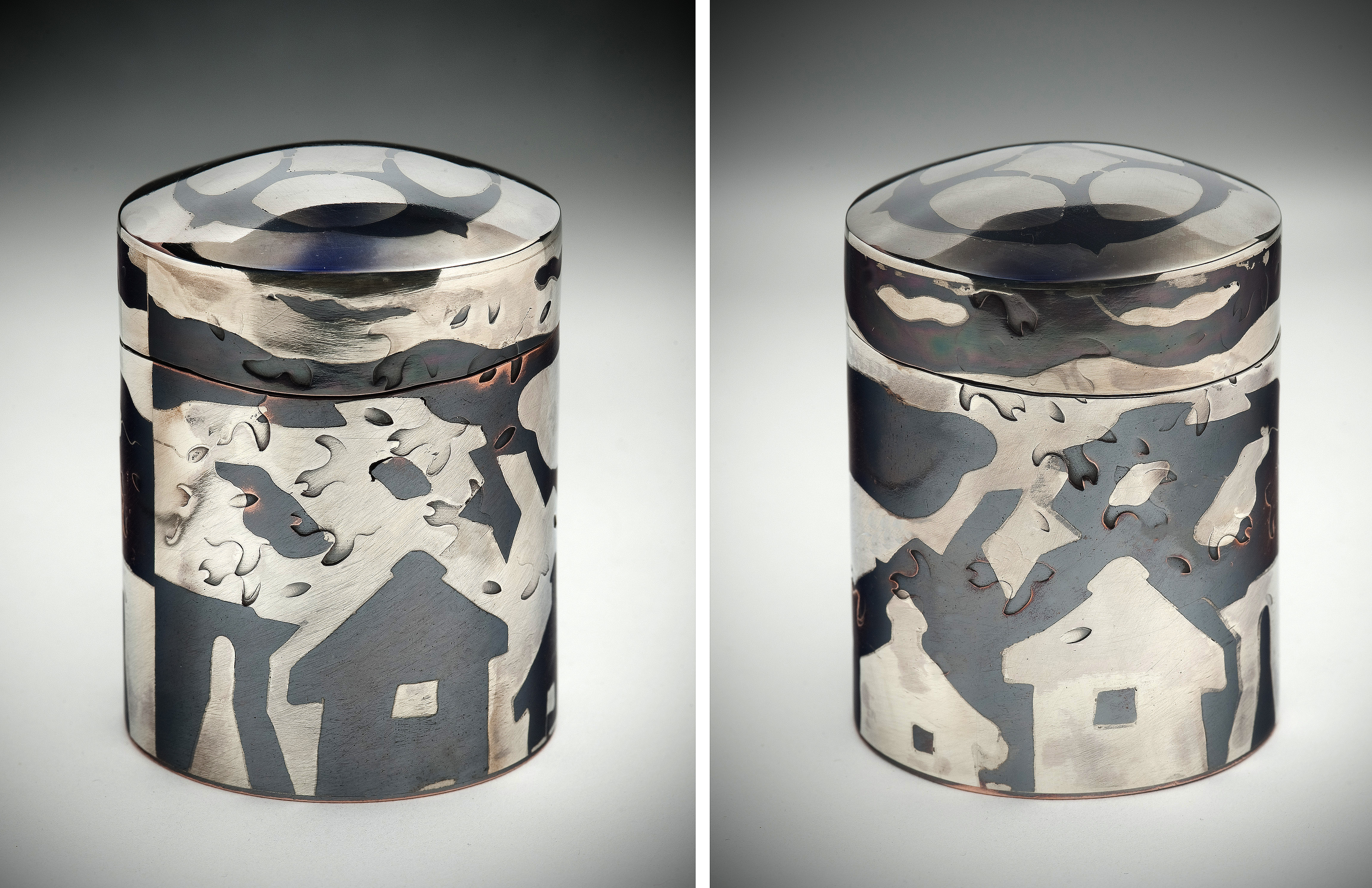
Heirloom Oak Seed Container was created to contain an oak seed from the ancient forest in Poland, Bialowieza, World Heritage site of one of the oldest groups of oak trees in the world. Oak, a universal symbol of strength and endurance, is embedded in cultural landscape myth and memory. I drew the oak trees in my yard and laid out the design to create a combination of silver and copper sheet metal. This technique known as married metals or metal mosaic requires soldering numerous pieces of metal together side by side. In this container, there are over 60 pieces. The sheet metal was roller printed with leaf textures, formed into a cylinder, soldered, the top and bottom soldered in place, a cut made around the circumference of the cylinder, and then a flange soldered in the bottom section of the cylinder. The top branch element was cast in silver and bronze from an oak twig in my yard. I then set a peridot cabochon in the acorn cup suggesting new growth.
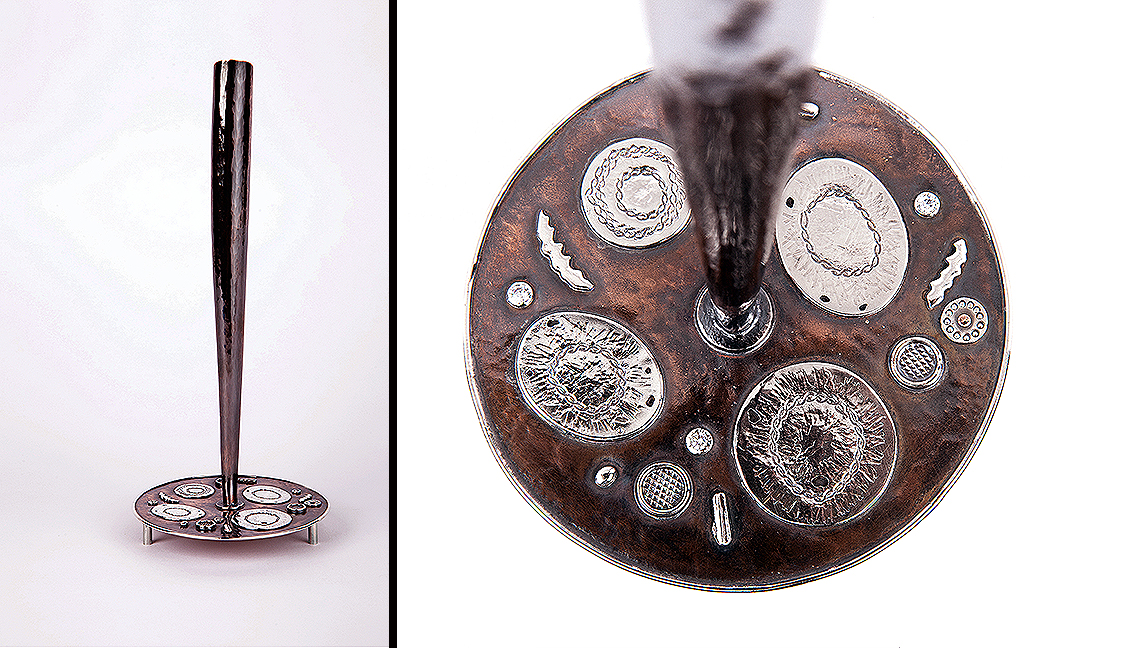
Cells in Water Vase — copper, sterling silver. 7.5” x 3” x 3”
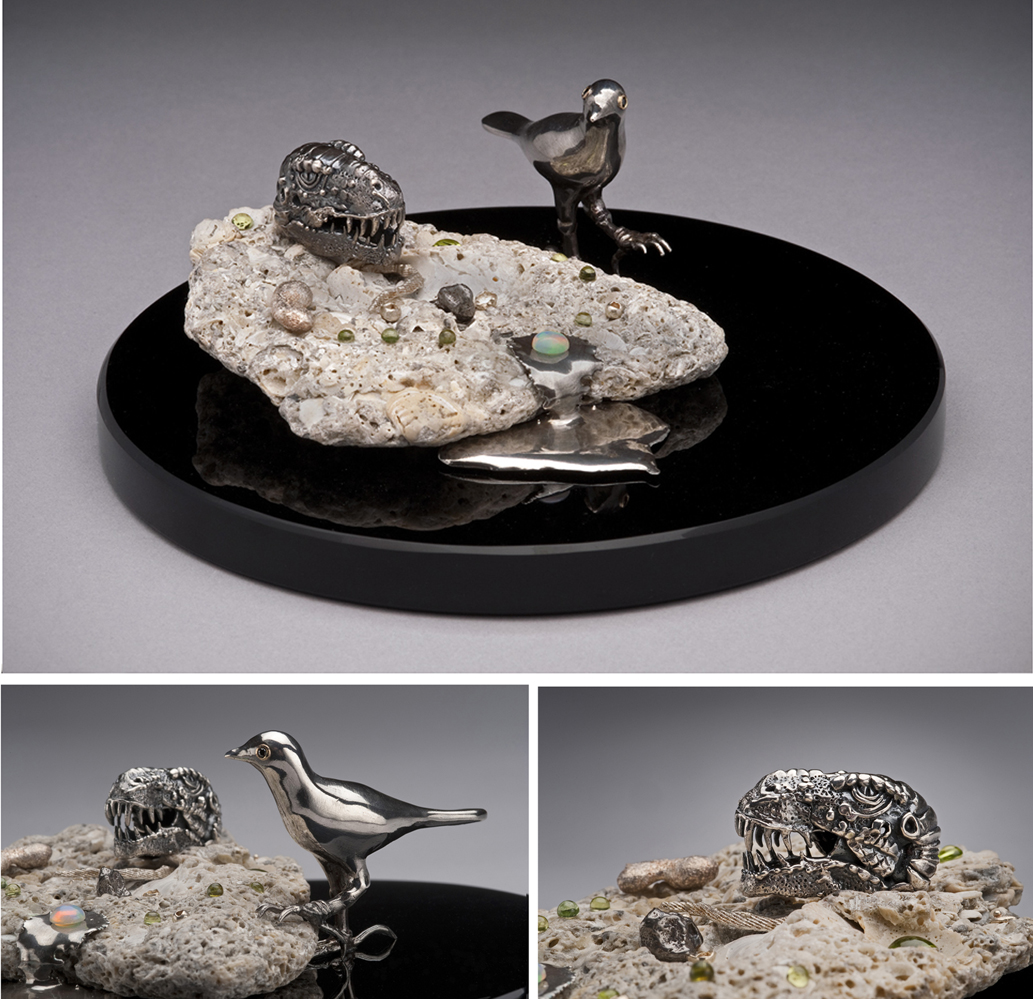
Evolution/Panspermia — My Evolution/Panspermia diorama is a condensed scene of two theories of life on earth represented with a Tyrannosaurus Rex dinosaur head (carved in wax, cast in silver) which has evolved into a modern-day bird (carved in wax, cast in silver). A meteor (represented by a fragment of iron meteorite) has hit land (a rock found on a beach in Florida) and brought with it DNA (represented by an opal) from space. The DNA finds conditions suitable for life and evolves (represented by peridots) into new, mutable, lifeforms (silver and bronze shapes). The diorama is supported on a round disc of volcanic glass, Obsidian, from Mexico, site of a meteor crash in the Yucatan peninsula which is believed to have led to the extinction of dinosaurs. sterling silver, 14K gold, obsidian, beach rock, peridot, opal, meteorite. 6” x 6” x 3”
http://www.panspermia-theory.com/videos
Panspermia theory: the origin of life on Earth and the transfer of life throughout the Universe. Three popular variations of the hypothesis are: directed panspermia — the intentional transfer of life to other planets by intelligent life; lithopanspermia — extremophile bacteria traveling through space within a meteorite, asteroid or comet from a planet in one solar system to a planet in another solar system; ballistic panspermia — extremophile microbes traveling through space within meteorites, asteroids or comets between planets within the same solar system, such as from Mars to Earth Panspermia has been explored by the astrobiology community and endorsed by astrophysicist Stephen Hawking and Nobel Prize winner, Professor Francis Crick.
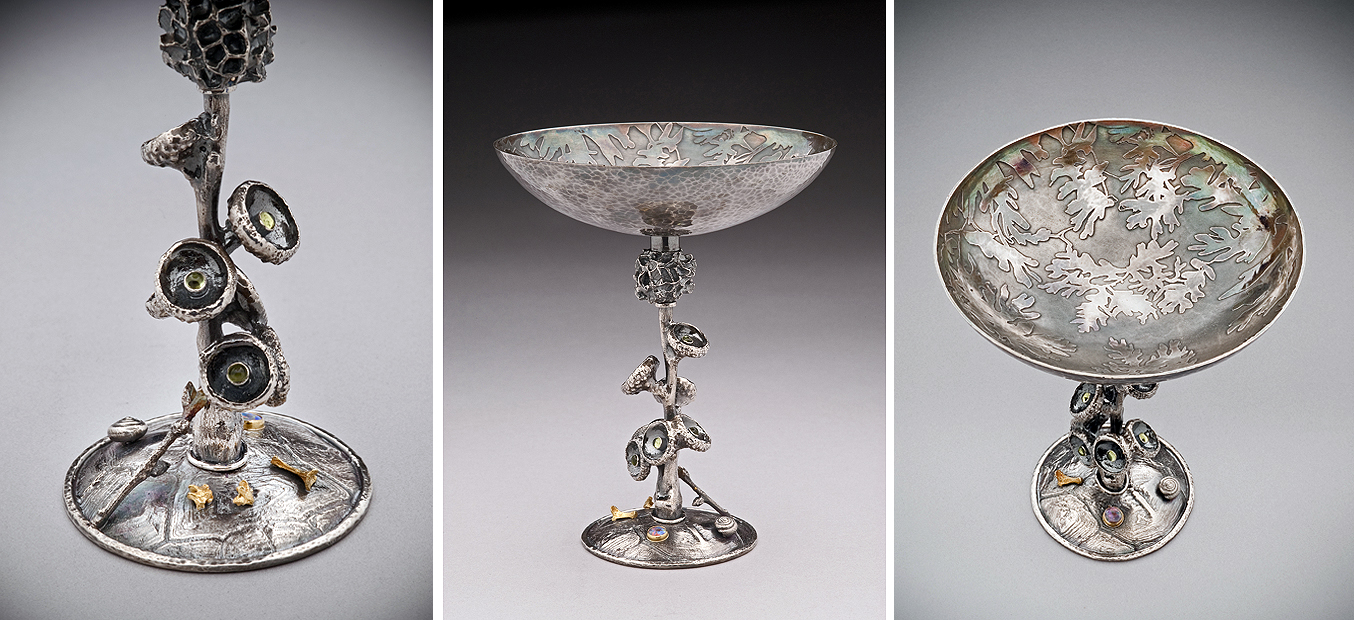
A Walk in the Woods in Georgia — After my daily walk in the woods, I always seem to return home with something from nature in hand: a beautiful piece of bark, a twig with a particular shape, a rock, feather, bone, leaf or flower. The vessel I have made is a collection of several found elements brought together to form a receptacle to highlight and hold treasures. The silver base of the vessel has the texture and form of a turtle’s shell on which sits a cast gold snail shell, a cast gold bone of a mouse, an opal suggesting a drop of water and a cast tulip poplar twig resting on the stem of the vessel. The stem is a molded and cast branch of an oak tree with acorn cups filled with green peridot stones suggesting new growth. At the top of the stem is a silver cast sweetgum tree seed pod which supports a silver bowl etched with the silhouette of oak leaves as seen overhead in the tree canopy. sterling silver, 14K gold, brass, opal, peridot. 6” x 5” x 5”
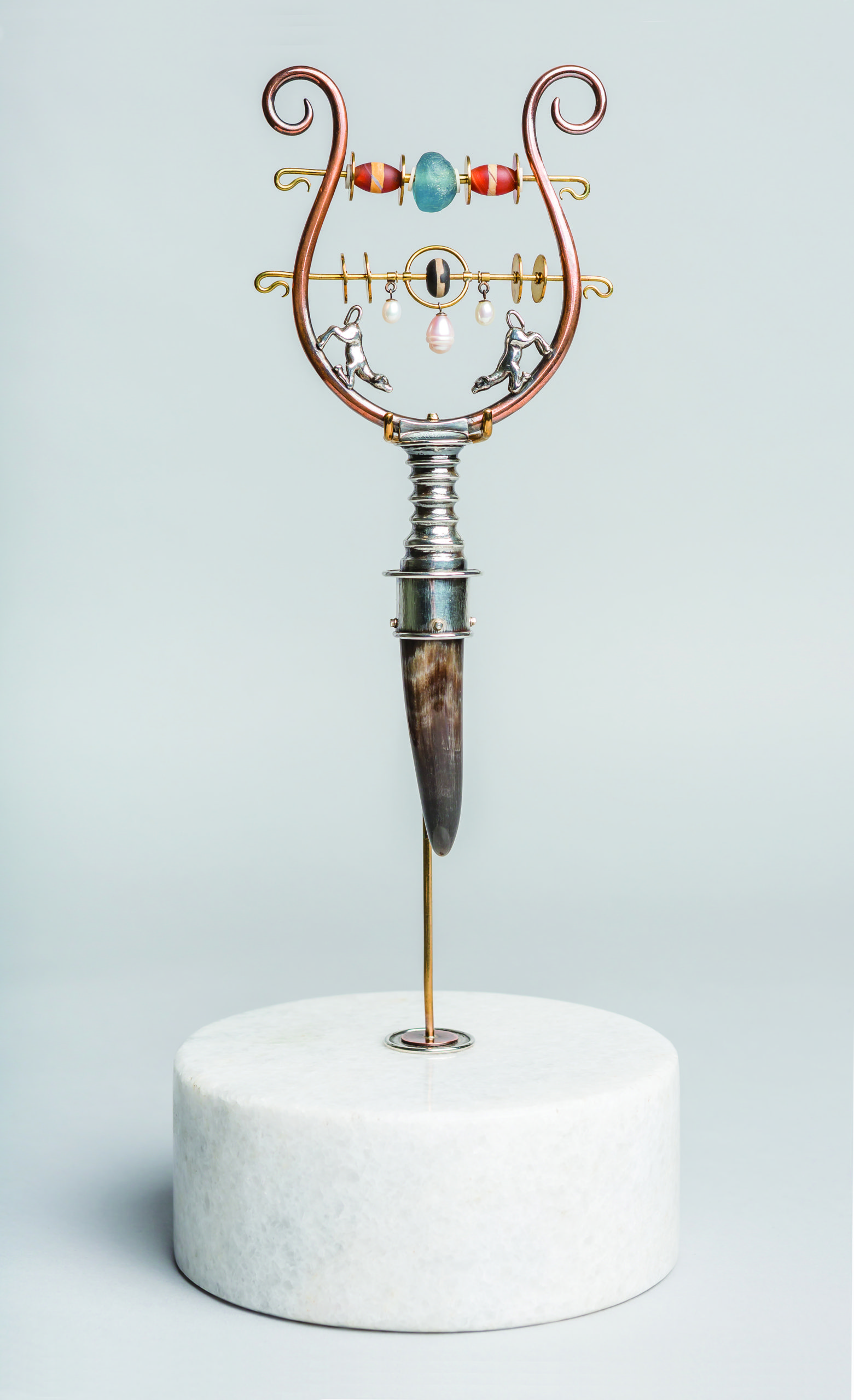
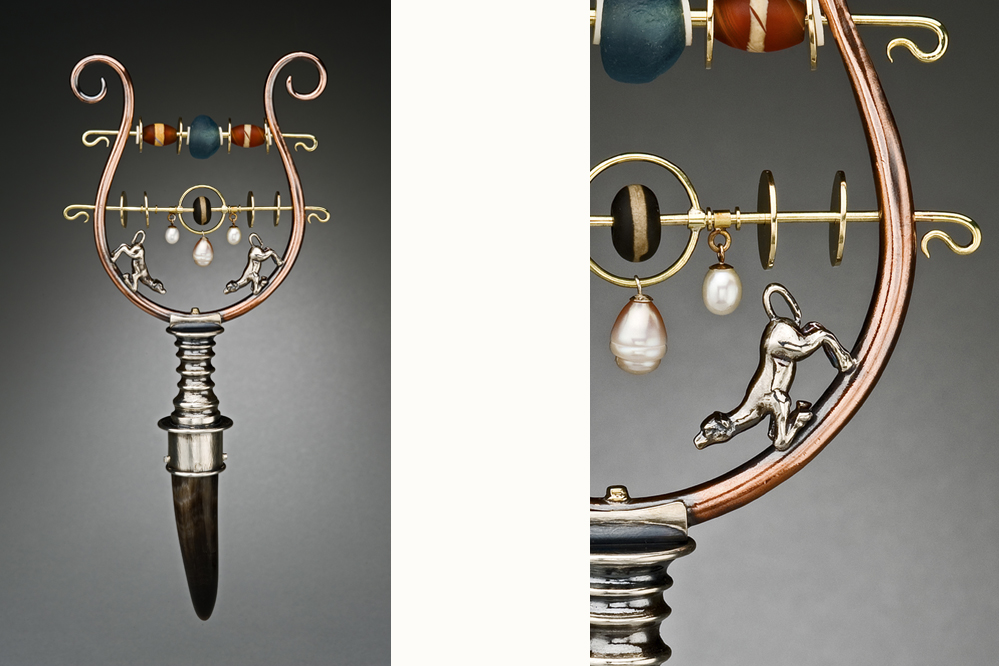
Cloning Calves Sistrum — The sistrum was a musical instrument used in ancient Egyptian and Greek ceremonies to ward off death and encourage vitality. It was believed that all things on earth needed agitation to survive, symbolized by shaking of the rattle – similar to a tambourine. The sistrum is a representation of life and death, motion and inactivity. My cloned calves sistrum is intended to abet the positive benefits of cloning and the propagation of life. copper, brass, sterling silver, cow horn, antique glass, agate, ceramic, pearls. 4″ x 1″ x 9″
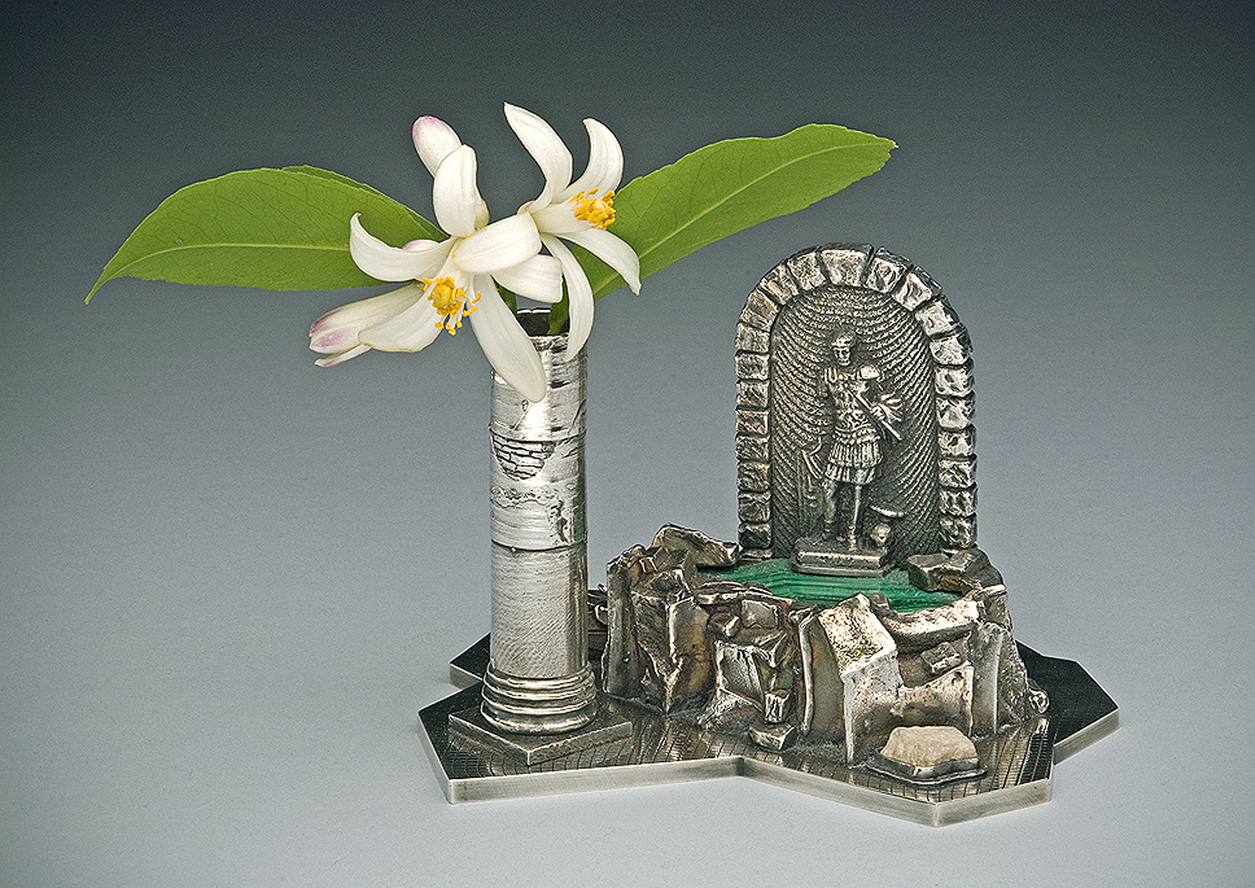
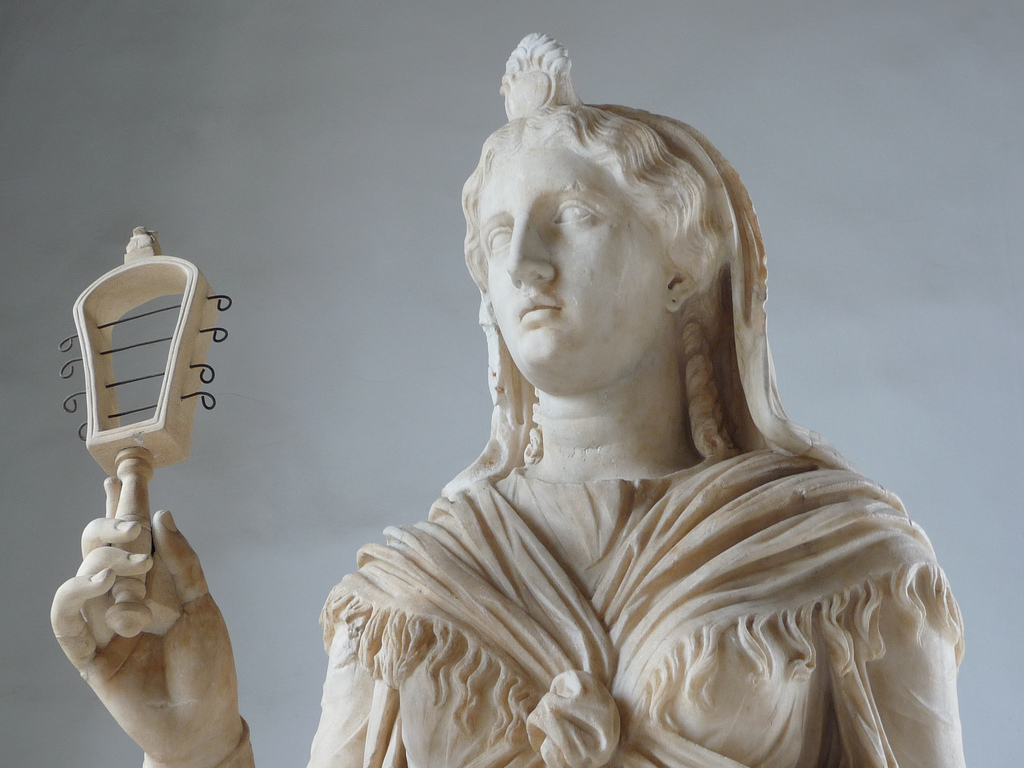 First-century AD statue of Isis found at Hadrian’s Villa
Postcard from the Universe — reticulated sterling silver, fine silver, 18K, 22K, 24K gold, lab ruby, pearls, white sapphires, Meteorite, opal, brass. 3” x 5”
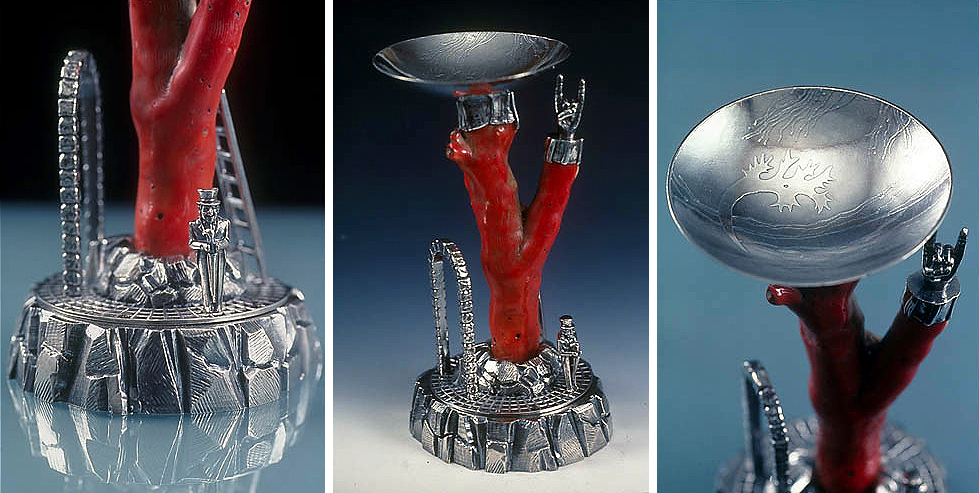
Good Luck to Stem Cell Research – This offertory vessel was made to give stem cell research a push in a positive direction. It consists of a central piece of branch coral representing a red, healthy nerve. For thousands of years coral has been a symbol of good luck in most cultures. The coral rests on a rock-like formation which suggests that stem cell research has a good foundation. The geometric paving pattern on top of the rock is ordered, logical, civilized and is shaped like a Petri dish. The stone archway serves as a portal, an opening to another space, and an opportunity. The small hunchbacked man, known in Italy as gobbetto, is a symbol of good luck and a harbinger of good things to come. The ladder resting against the coral represents an ascending path, taking research to the next step. At the top of the coral is a mano cornuta, hand posed in the gesture of good fortune, strength, fertility and power. The topmost bowl is etched with the image of a nerve cell and stem cells growing into nerve cells. sterling silver, coral; cast and fabricated, 8” x 4” x 4”
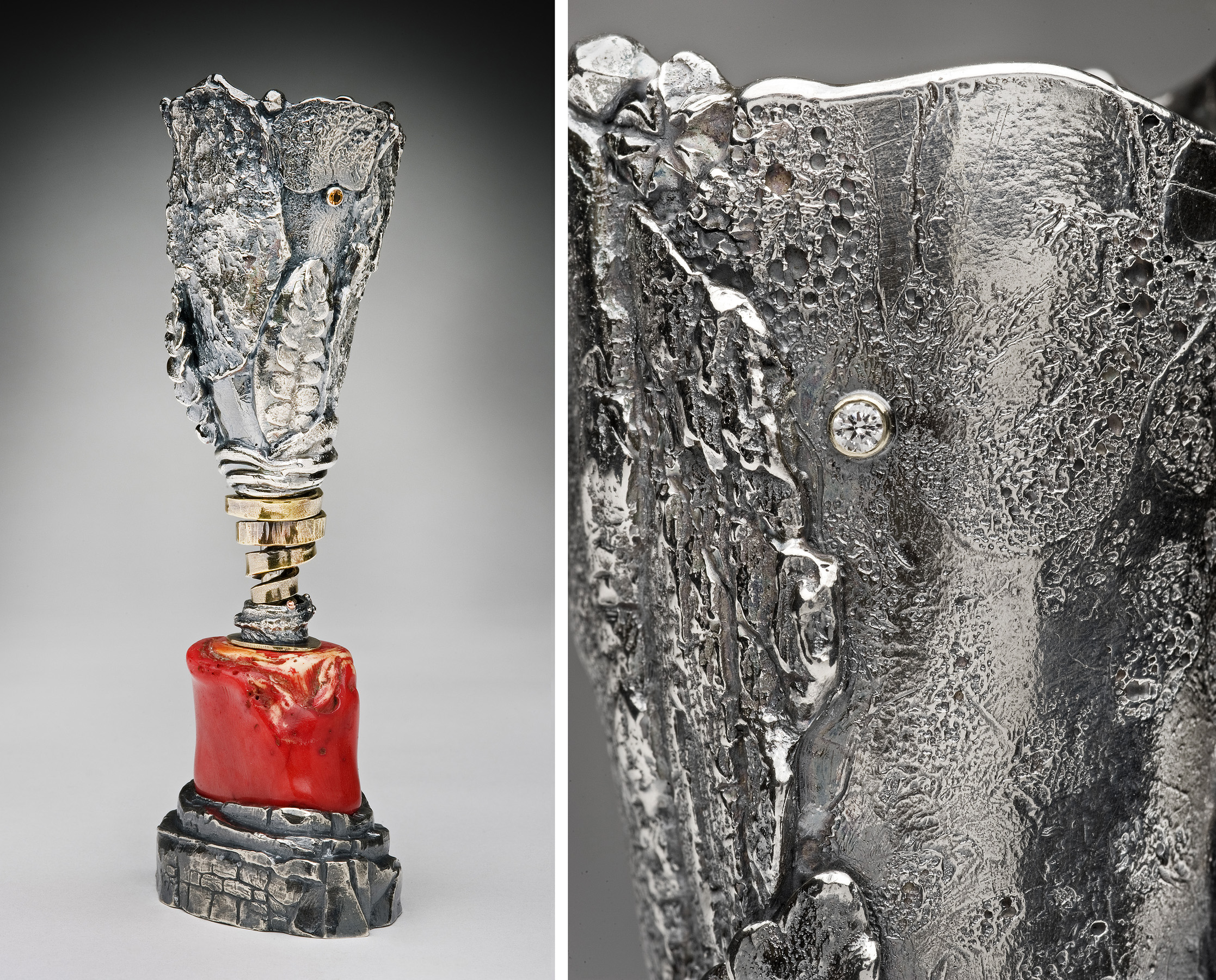
Dante’s Divine Comedy; Climb to Utopia — This vessel was inspired by the14th-century allegorical poem, by Dante Alighieri, about sin and redemption. In the poem, Dante visits Hell, Purgatory and Heaven. At the base of the vessel, I have represented his time in purgatory by three of the terraces of the seven-story mountain that he climbs as he ascends toward purification. I chose three terraces because 3 is a highly symbolic and recurring number in the entire poem. The red coral represents the process of purification, and the brass spiral signifies the rapid ascent into the divine cosmos of Heaven. Heaven is represented in the cup of the vessel by the plants and flowers of the Garden of Eden, with the sun and stars suggested by the diamonds and yellow sapphires set into the silver. The image of Dante, as it appears on the Italian Euro, is embedded into the organic texture of the surface of the cup. sterling silver, 18k gold, brass, coral, diamonds, sapphires; 6.25” x 2.5” x 1.75”
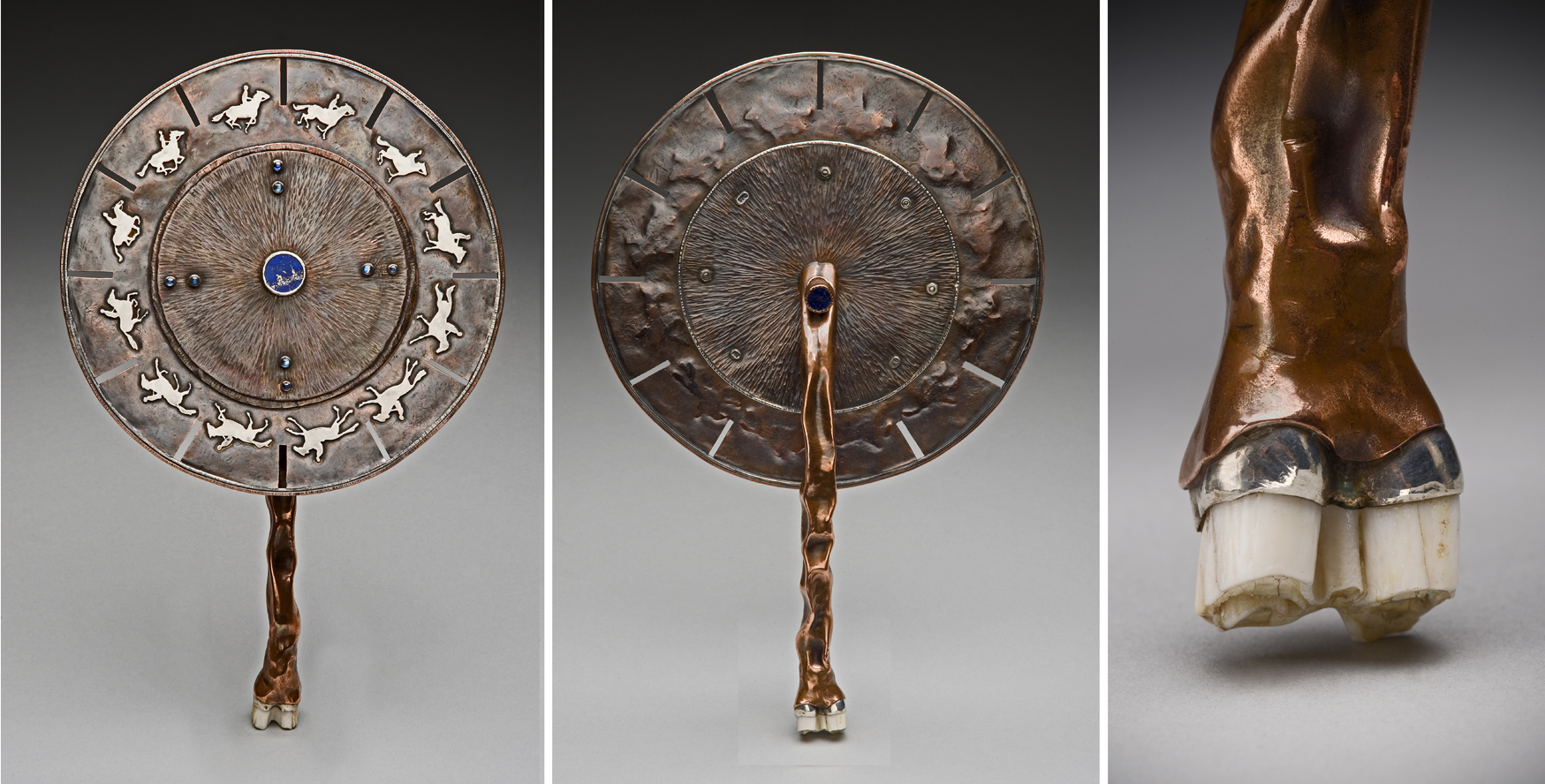
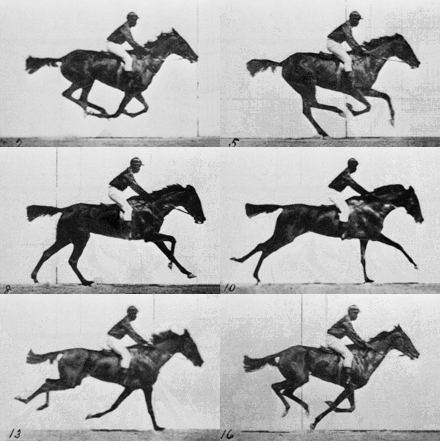
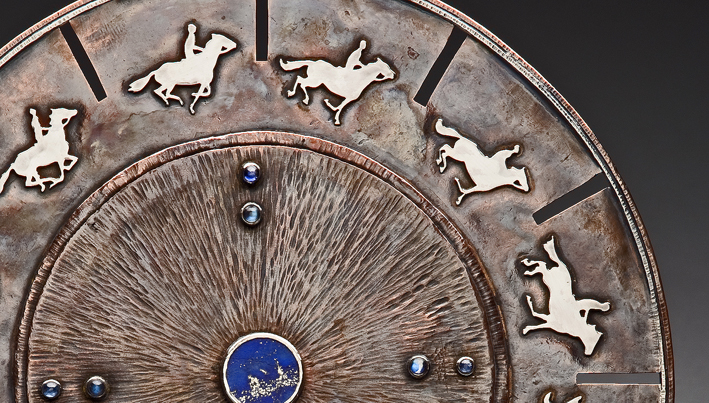
Phenakistoscope – This instrument was one of the earliest devises that enabled the viewer to observe an illusion of motion. Invented in the early 1800s, it consisted of a wheel with the animation sequence (separate images) drawn in a series around its circumference. Slits were cut in the wheel, and it was mounted vertically in front of a mirror. The viewer would spin the wheel while looking through the slits to see a rapid succession of images reflected in the mirror. This gave the appearance of animated motion. I have animated a galloping horse and rider taken from stop-action photos by Eadweard Muybridge, called “the father of the motion picture.” My inspiration for making this toy came from creating flip books and my admiration for horses. copper, sterling silver, Labradorite, lapis lazuli, horse tooth, 7” x 1” x 10”
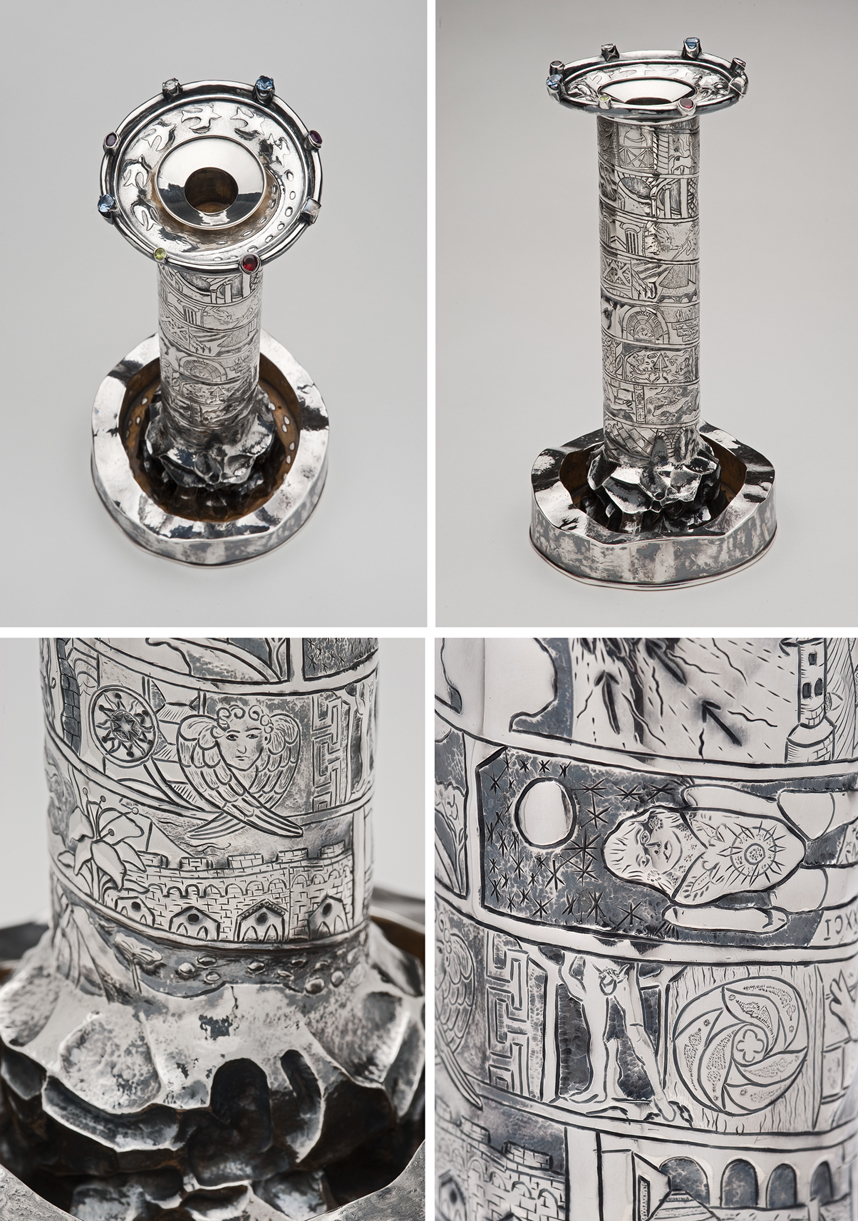
Diary of Italy – Trajan’s Column Candlestick — Barbara created this candlestick to document all of the places she and students visited in Italy during the summer of 1979, while she was a resident artist and her husband taught landscape architecture with UGA’s study abroad program in Cortona. She finished the candlestick in Athens in 1981, the same year that the jewelry and metalwork program, under Gary Noffke, first offered courses in Cortona. Barbara has taught as an instructor in the area frequently, and in the UGA study abroad program in Cortona nine times. sterling silver, bronze, brass, amethyst, aquamarine, blue topaz, garnet, moonstone, peridot, white sapphire. 10″ x 5.5″ x 5.5″
Mount Fuji in Clouds and Snow — Homage to Hokusai – teapot — I was born at the foot of the volcano, Mount Fujiyama, on a sunny day, full of clouds; snow covered the top of Mt. Fuji. My family lived for five years in Yokohama, Japan and then moved to the base of another volcano, Mount Vesuvius in Naples, Italy, for another five years. While I was growing up, our homes were full of Japanese and Italian art and objects. I always have been fascinated with the work of the Japanese artist, Hokusai, especially with his series of views of Mount Fuji. The teapot I made,” Mount Fuji in Clouds and Snow — Homage to Hokusai,” is a view of the volcano in Yokohama, Japan. I was born in Yokohama at the foot of Mt. Fuji where my family lived for four years. The spout of the teapot is a view of a portion of a bridge in a Hokusai print. The teapot is fabricated from sterling silver sheet with cast elements soldered to the cone form of the volcano. The bottom and top clouds are pierced from sterling sheet. The cloud, which is the handle, is a lost wax casting. The topmost cloud is a cuttlefish casting. The textured sheet silver, on the lid of the teapot, is reticulated silver (800 parts silver, 200 parts copper). sterling silver, reticulation silver, 5.5″ x 4” x 3.5″
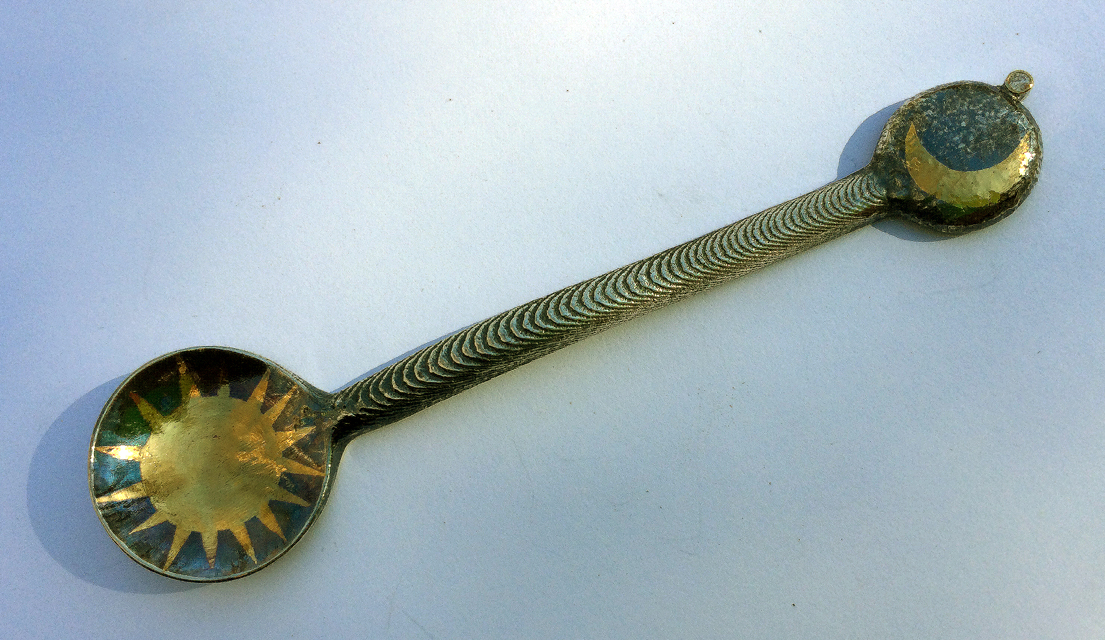
Passage of Time Spoon — The spoon is a representation of the diurnal cycle of the sun and moon and the flow of time. The spoon bowl is forged from the thick, gate section of a cuttlefish casting and has a layer of 24 karat gold applied to the surface in the shape of the sun with rays. The midsection of the spoon has the characteristic wavy texture of the cuttlefish mold and the waves refer to the repetition of days and flow of time. The end of the spoon is a hemisphere which is the residual silver left in the crucible after pouring into a mold. The hemisphere was soldered onto the cuttlefish casting, then, 24K gold, in the shape of a crescent moon, was applied to the surface in an ancient Korean process known as Keum-Boo. A tube-set diamond, suggesting a star, was soldered onto the hemisphere. In T.S. Eliot’s poem, “The Love Song of J. Alfred Prufrock,” the line “I have measured out my life with coffee spoons” conveys another interpretation of the cyclical nature of time combined with the image of a spoon. sterling silver, 24 karat gold, 18 karat gold, diamond; cast and fabricated, 5” x 1” x 5”
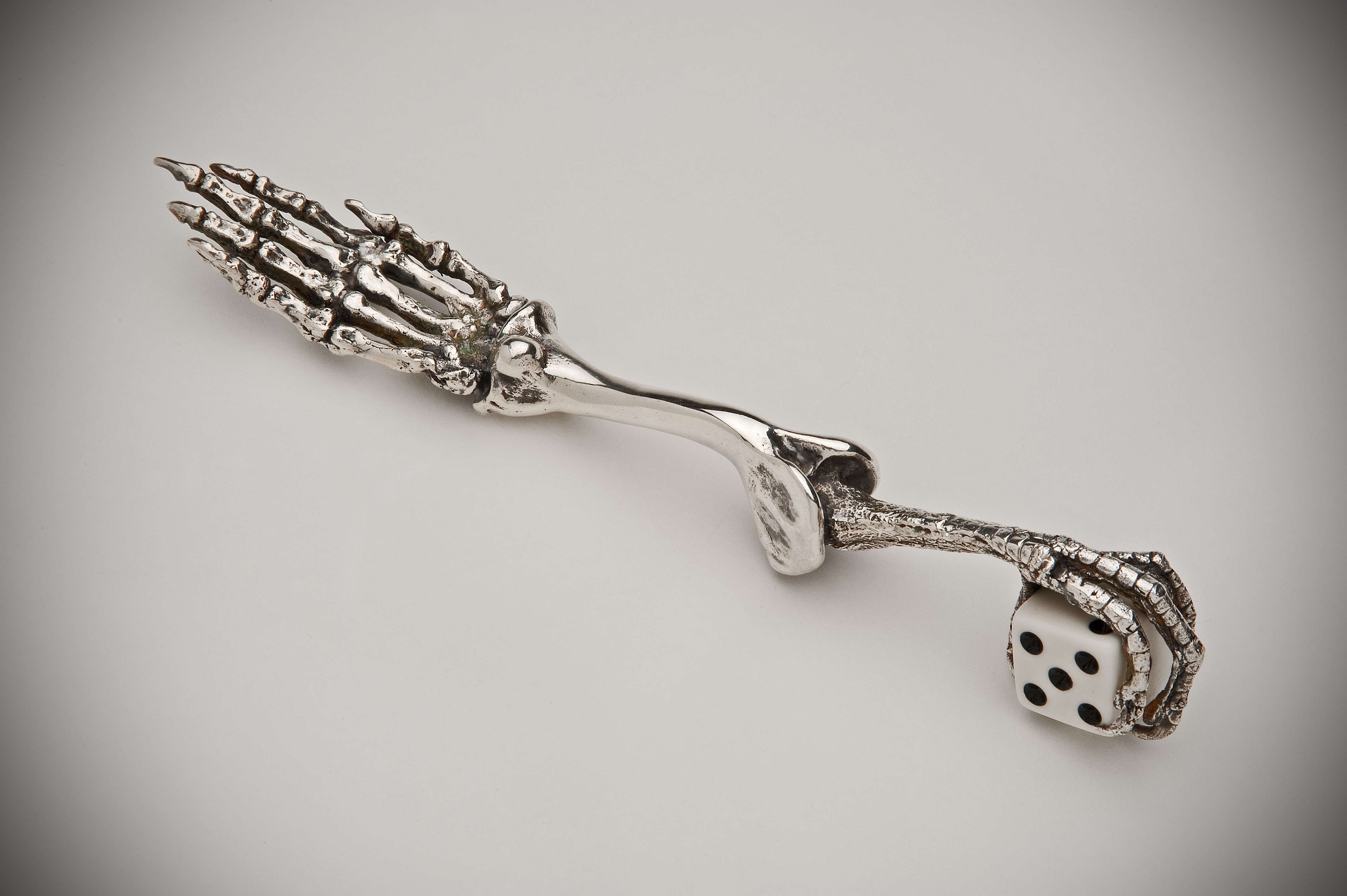
What You are Now is What We Used to Be; What We are Now You Will Be — The sterling silver fork is a memento mori, a reminder of mortality. The title “Quello che voi siete noi eravamo; quello che noi siamo voi sarete,” is a phrase often seen on tombs and monuments in Italy. Alluding to life, death and chance, the human hand and arm bones evolve into a bird’s claw which is grasping a die, a symbol of chance. sterling silver, plastic die; cast and fabricated, 7” x 1” x 1”
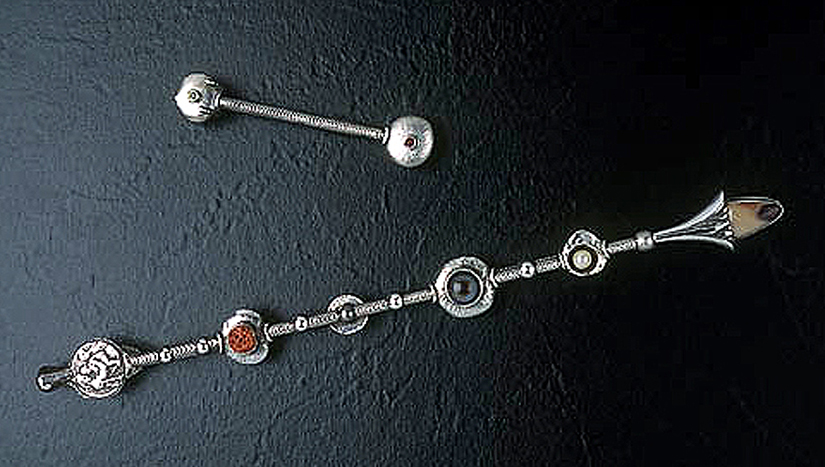
Healing Wand — The “magic wand” is a combination of icons, symbols and materials of hope, persuasion and charms from the Stone Age to Space Age. Titanium, coral, Raphael’s Virgin and Child, the Pope, stem cells, the perfect egg, the evil eye antidote in the form of ancient Roman eye agate and the Egyptian lotus terminate in the healing touch of the agate ”finger.” sterling silver, fine silver, titanium, coral, pearl, agates, 24 K gold; cast and fabricated
Passage of Time Spoon — The spoon is a representation of the diurnal cycle of the sun and moon and the flow of time. The spoon bowl is forged from the thick, gate section of a cuttlefish casting and has a layer of 24 karat gold applied to the surface in the shape of the sun with rays. The midsection of the spoon has the characteristic wavy texture of the cuttlefish mold and the waves refer to the repetition of days and flow of time. The end of the spoon is a hemisphere which is the residual silver left in the crucible after pouring into a mold. The hemisphere was soldered onto the cuttlefish casting, then, 24K gold, in the shape of a crescent moon, was applied to the surface in an ancient Korean process known as Keum-Boo. A tube-set diamond, suggesting a star, was soldered onto the hemisphere. In T.S. Eliot’s poem, “The Love Song of J. Alfred Prufrock,” the line “I have measured out my life with coffee spoons” conveys another interpretation of the cyclical nature of time combined with the image of a spoon. sterling silver, 24 karat gold, 18 karat gold, diamond; cast and fabricated, 5” x 1” x .5”
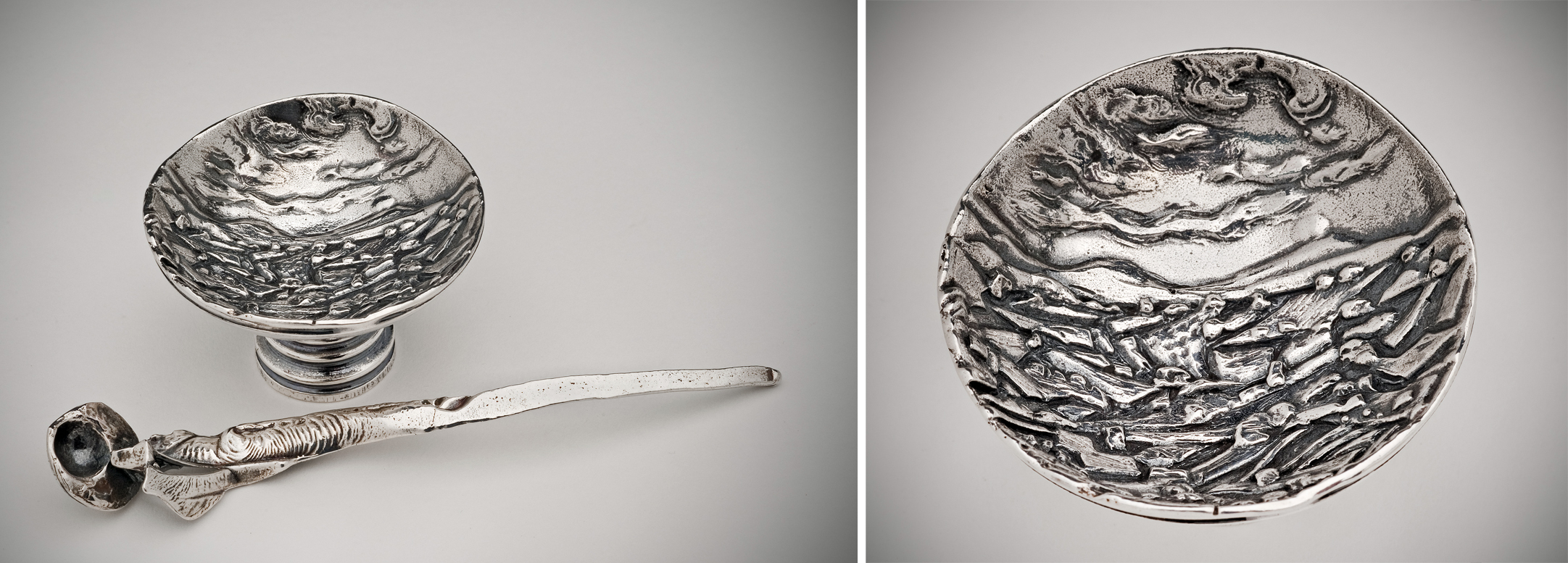
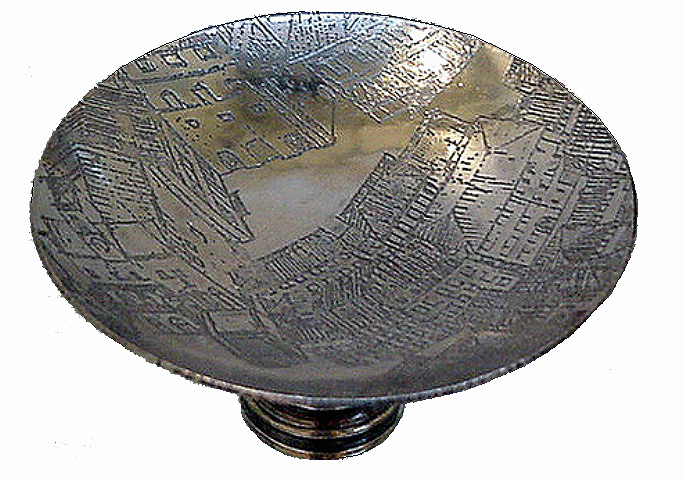
Italian Landscape — Salt Cellar Bowl and Spoon — The spoon is a representation of the Val di Chiana landscape as seen from the hilltop town of Cortona, Italy. The patchwork pattern of the fields and crops lined with cypress trees and farmhouses is surrounded by the mountains and Lago Trasimeno. This was where Hannibal’s Carthaginian Army’s defeated the Romans after crossing the Alps into Italy in 217BC. sterling silver; cast and fabricated, 7” x 2” x 2”
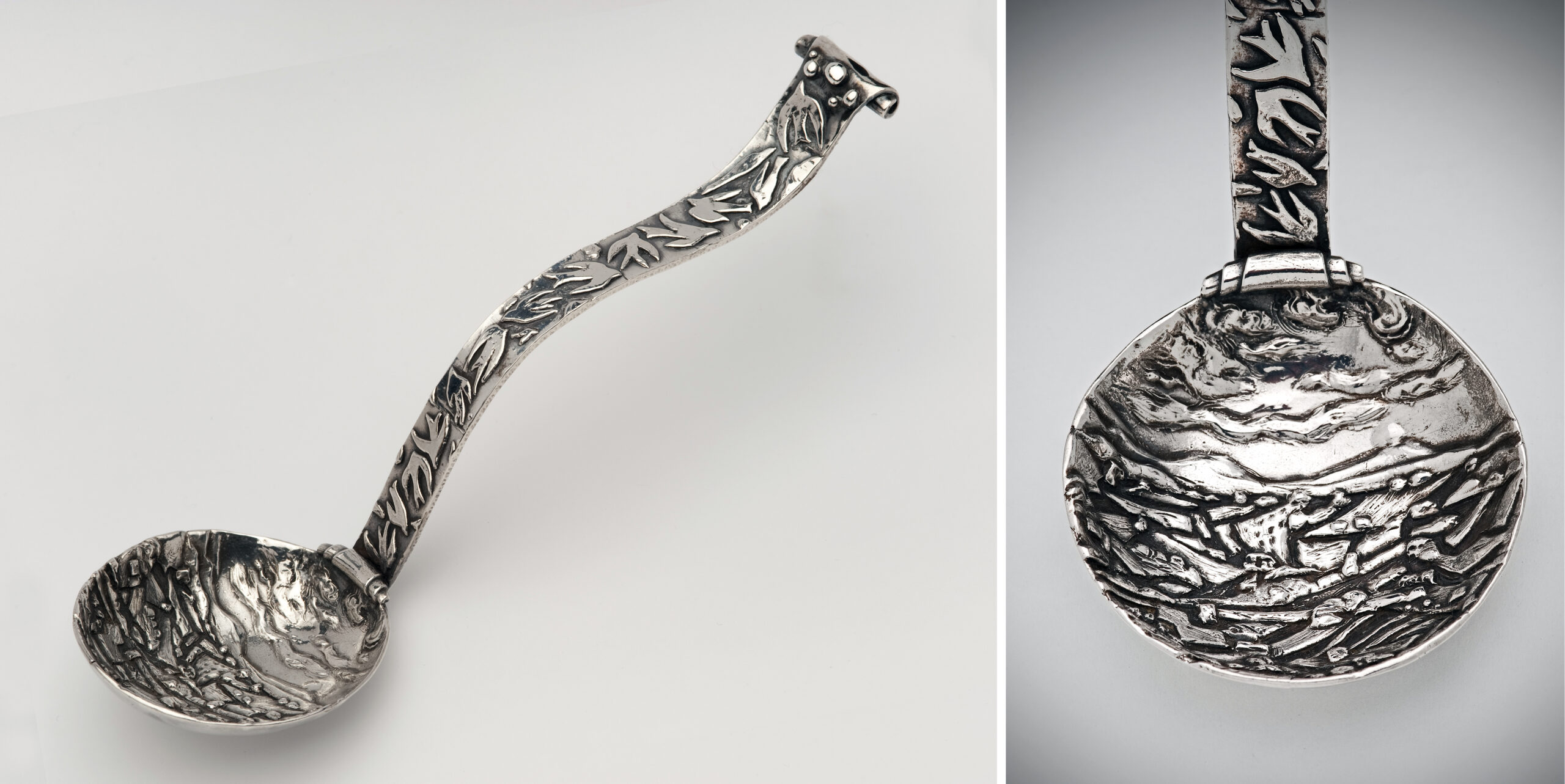
Cortona Landscape Spoon — The handle of the spoon has swift birds flying as in the sky above the valley. The terminus of the spoon handle curves into the shape of a variety of pasta. sterling silver; cast and fabricated, 7” x 2” x 2”
The following descriptions are from Professor Dorothy Joiner’s review of “Barbara Mann: Form and Response,” Malone Gallery, Troy University, Troy Alabama, 2011. MetalSmith Magazine, August 2011, pages 4 & 52
“Barbara Mann: Form and Response,” Malone Gallery, Troy University, Troy Alabama
Because contemporary taste has tended to devalue beauty, and because jewelry is inevitably associated with the beautiful—few would adorn themselves with something ugly—jewelry has sometimes been assessed as craft rather than as “fine art.” Belying this prejudice, however, Barbara Mann’s works are sculptures in miniature, incorporating not only witty plays of form but also wide-ranging allusions to science, faith, and tradition, often evoking aesthetic meditations on life and death. Form and Response, a recent exhibition of her work at Troy University, displayed a wide range of the artist’s rings, brooches, pendants, necklaces, spoons, and liqueur cups, all expertly crafted in gold and silver.
Reflecting Mann’s interest in science as well as a more personal association, Creation Stem Cells Brooch (2010) imitates a circular petri dish incubating stem cells, their branch-like extensions stretching toward each other in the miracle of growth. With an aesthetic alchemy, Mann transmutes these configurations into the celebrated creation scene from the Sistine ceiling, in which God the father reaches toward Adam, infusing his languid figure with vitality. Three rubies set in gold indicate health, and twinned diamonds convey energy. Irregular perforations of the surface offer depth at the same time that they adumbrate deterioration, the inverse of growth. Mann’s interest in these nerve-growing stem cells derives from her son’s struggle with Lou Gehrig’s disease, or ALS, a malady attacking the nervous system.
Research Mice as Saints (2010), a necklace also inspired by medical research, punctuates a string of reiterated brass washers with three silver mouse skulls, each crowned with a tiny halo, emblem of sanctity, earned by sacrificing their lives to research. Inscribed on each washer, the designation SOD1 indicates the enzyme now considered a possible cause of some forms of ALS.
Other works allude to life after death in a particularly creative way. A spiral of forged silver wire wraps around the white coral stem of Swing Low Sweet Chariot Liqueur Cup (2010). Undulations on the diminutive chalice indicate clouds, and the gold that fills a ragged crack near the lip symbolizes a burst of sunlight. An irregular pearl projecting from the stem suggests the “ pearly gates” of heaven, and a diminutive sphere of gold on the spiral refers to the wheels of the fiery chariot that descended in a whirlwind, taking up the prophet Ezekiel ( 2 Kings 2:11), Biblical source for the hymn from which the cup’s title is taken. On the underside of the base, a circle of lapis lazuli, whose hue refers to the heavens, is an emblem joining earth to sky. Mann’s cup brings to mind Jean Chevalier’s assessment of the chalice as “a vessel holding the draught of immortality.”
Echoing this theme, The Everlasting Life Bracelet (2004) relies on a motif from the famous mosaic in Ravenna repeated ubiquitously in Italian cemeteries: paired doves representing souls drinking from a fountain, symbolizing the waters of life. Adapting this convention, Mann layers stylized birds in polished silver over a textured base, somewhat like a palimpsest. Black diamonds create their eyes; and, set between them, white diamonds and blue aquamarines refer to the pure spiritual waters they imbibe.
The artist also takes inspiration from Europe’s natural beauties, as in her light-hearted Mediterranean Brooch (2002). Wavy patterns on the graceful ellipse cast from a cuttlebone replicate the surface of the sea. This shape also suggests a boat whose gold railing is punctuated by freshwater pearls. Cabochons, one yellow glass for the sun, the other turquoise for the sea, indicate the intense colors of the region. A cast silver scorpion in the center stands for the continuity of life from prehistory to the present, and the diamond between its claws indicates both the resplendent light and a captured treasure.
Mann’s artful jewelry, rich in allusions to art, science, and the charms of nature, certainly provide handsome adornment. But at the same time these bantam sculptures offer much more, inspiring the viewer to ruminate on the great imponderables of nature, life, and death and on their intersection with modern science.
Dorothy Joiner is the Lovick P. Corn Professor of Art History, LaGrange College, LaGrange GA 30240
email: bimann2@hotmail.com